Everybody Loves a Cinderella Story
Back in 5th grade, my friends and I would spend our entire morning period staring at the clock on the wall. We would bounce up and down waiting for lunch period—not so much because of the food (it was usually terrible), but for what awaited us during recess. As soon as the bell rang, we would jump out of our seats and race to the field to play an intense game of soccer with the middle schoolers. Looking back, I can barely remember any instance where we beat them – they were stronger, faster, and much more skilled than us. But every day, our little group shook off our previous defeat and marched into the field just to get another chance at victory.
So why did we keep doing this? After the bloody noses, bruises, and inevitable losses, what made us walk onto the soccer pitch every lunch period?
The answer is simple: everyone loves an underdog story. In sports, nothing creates more excitement than a major upset, where athletes who are heavily expected to lose squeeze out an impossible victory. Media industries are always hungry to capture the latest news on Cinderella runs, turning them into engaging narratives that captivate their audience.
The definition of the term "Cinderella run" is quite self-explanatory. Cinderella is a fairytale princess who rose from poverty and mistreatment to the glamours of royalty. Thus, people have begun to apply ‘Cinderella’ to describe any instance where a team or athlete goes on an unexpected winning streak. The historical use of the term can be traced all the way back to the 1930s, where sports writer Damon Runyon called a boxer named James J. Braddock ‘Cinderella Man.’ At the time, Braddock was considered past his boxing prime, and was working manual labor jobs at the dock while substituting as a last-minute replacement for fights. When he was given a title shot against the reigning heavyweight champion, Max Baer, Braddock shocked the world by winning in convincing fashion.
But the term “Cinderella run” became more mainstream when describing underdog teams in March Madness. March Madness is the annual College Basketball Championship tournament, where 68 teams in Division I compete in a single-elimination knockout format. No matter how strong a team is, one loss can completely end their season, which has led to major upsets and Cinderella runs in the tournament’s rich history. The term became more popular after sports commentator Gus Johnson’s iconic quote, “the slipper still fits!” after the underdog college team, Gonzaga, continued their miraculous run to the top 8 stage.

When we look at the NBA, Dirk Nowitzki’s championship run in 2011 instantly comes to mind as one of the league’s famous Cinderella stories. Dirk was a 7-foot-tall power forward for the Dallas Mavericks, and he specialized in scoring from all areas of the court. But before securing a championship, Dirk had a reputation for underperforming in the playoffs, most notably blowing a 2-0 lead in the 2009 Finals and losing as the 1st seed to the 8th seed Warriors in 2007. By 2011, the Mavericks were still a strong team to be reckoned with, but very few analysts expected them to go far, especially since opposing teams were getting stronger every season. The Mavericks finished the season strong with a 57-25 record, but they had a tall task ahead of them for the playoffs.
Dallas started the first round by facing a formidable opponent in the Portland Trailblazers, but managed to beat them in 5 games—partially thanks to the help of injuries to Portland’s key players. As they moved onto the 2nd round, they faced the defending champions in the Kobe Bryant-led Los Angeles Lakers. The Mavericks went on a hot shooting streak and surprised many by winning all 4 games and accomplishing a sweep. In the Western Conference Finals, Dallas went against the Oklahoma City Thunder, led by young superstars Kevin Durant and Russell Westbrook. Dirk put his team on his back by averaging 32 points per game, comfortably beating the Thunder 4-2. The Mavericks now faced the Miami Heat with the best player in the league at the time, LeBron James, in the NBA Finals. After going down 2-1, Dirk led his team to 3 straight wins, securing Dallas’ first and only championship to date. Dirk Nowitzki’s 2011 championship run embodies the appeal of the underdog, as his Championship run is still considered one of the greatest and most difficult paths to winning an NBA title.
In tennis, Emma Raducanu is well-known for having one of the most unexpected Cinderella runs in the sport’s history. Unlike Dirk Nowitzki, Raducanu was not a well-known athlete before her historic win in 2021. She was actually ranked 150th in the world and entered the 2021 US Open as a qualifier. This meant that she would have to play 3 qualifying matches just to enter the main tournament. At the time, nobody knew much about Raducanu or her style of play, which proved to be a major advantage as she faced her upcoming opponents. Her main weapons were her strong serves and an incredibly patient playstyle, and she used them to control the place of her sets.
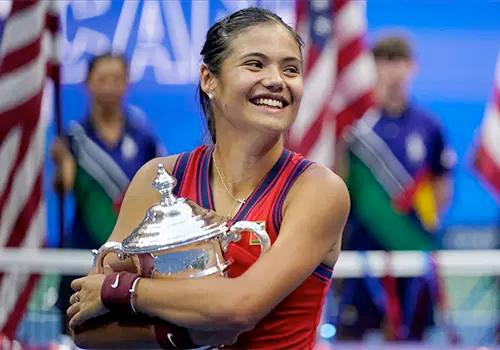
Emma Raducanu completely dominated her competition by winning 7 straight games and not dropping a single set throughout the tournament. Her iconic trophy win propelled her rank from 150th to 23rd, turning her from an unknown qualifier to a global star. Raducanu’s overall performance was not just a simple underdog story– it was an incredible mix of resilience, skill, and some luck. During her run, she had the great fortune of not facing a top-10 opponent and benefited from an unfamiliar playstyle that opponents had yet to adjust to. But players can only play those who are in front of them, and Emma seized the opportunity by becoming one of the youngest players to win an Open at 18 years old. As of 2026, Raducanu has unfortunately slipped to a 27th in global rankings due to inconsistencies in her play and back injuries. However, her historic Cinderella run, as well as her beaming expression as she embraced her trophy, will always be etched into tennis fans’ hearts.
What makes Cinderella runs so appealing to fans? At the end of the day, a win is a win, regardless of whether a team was favored or not. Yet, when an underdog overcomes all odds, it sparks a great joy for everyone to watch the athlete lift the trophy that seemed so impossible to reach.
Perhaps we all view our individual selves as the underdog in our lives, always fighting against a bigger force. As a student, you might be competing against thousands of others for your dream job. Later, as an employee, you could be vying with your colleagues for the promotion you’ve been working towards for years. Portraying ourselves as the underdog gives a reason to keep pushing, searching for that lightning-in-a-bottle moment that gives us the success we’ve always dreamed of.
When I look back at my 5th-grade self, I can’t help but smile. My friends and I were stubborn and blissfully unaware of how overmatched we really were. Our group would always huddle before a game, with imaginary “Rocky” music playing in the background as we got ready for another inevitable defeat. But to us, every match was our World Cup Final, and nothing could stop us from running out of our seats after morning period for another game. We knew the odds were never in our favor, but that only made the dream of winning feel so much bigger. After all, everybody loves a Cinderella Story.