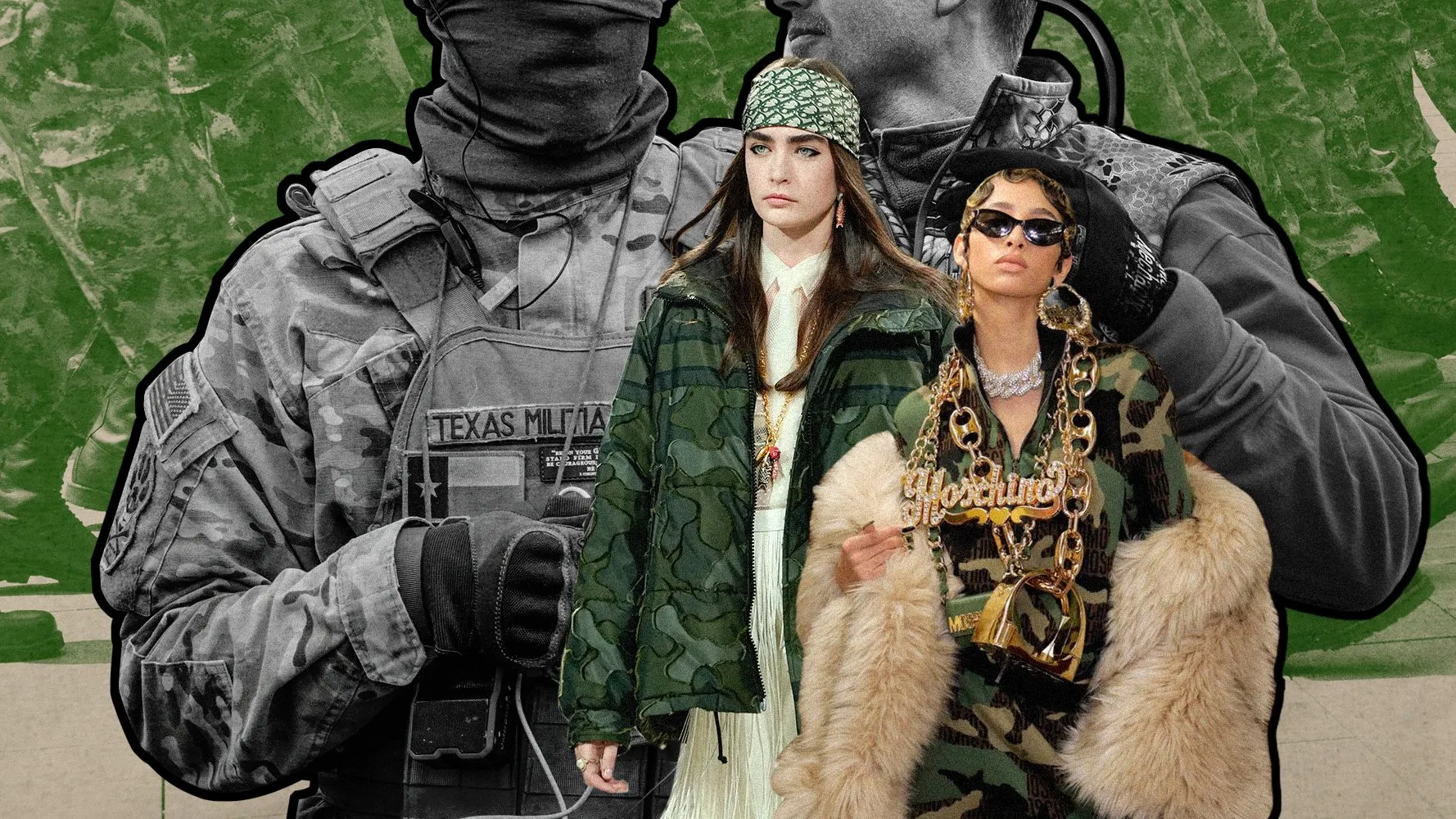
I haven’t tested this theory, but on a walk through a trendy Manhattan neighborhood, I’d expect to find at least one in three people wearing an item of distinctly military-inspired clothing. It may be combat boots, bomber jackets, aviator sunglasses, cargo pants, khakis, clothing covered in buttons, or simply a shade of army green.
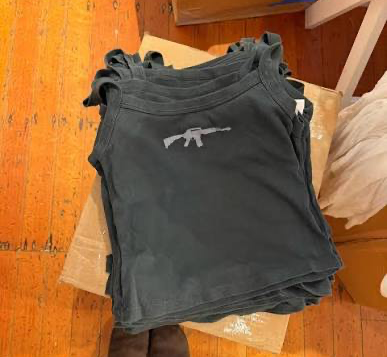
In fact, the military aesthetic has significantly expanded its civilian territory since 2015, when Troy Patterson observed that “[h]alf the people on the street are dressed to kill.” Even hairstyles like the slick back bun and more overtly-referential pieces like this off-putting gun printed tank top from Brandy Melville seem to fit into the broader visual language.
Camouflage is the clearest example. The pattern has become the definitive “new neutral” of the decade, so much so that Cosmo recently crowned it the “autumn print to wear instead of denim.” However, its global history and usage is more controversial than it may seem given its commercial ubiquity and normalization. In fact, in at least 20 nations across the Caribbean, Africa, and the Middle East, wearing camouflage clothing as a civilian is, to some degree, prohibited by law.
Since the early 20th century, the civilian meaning of military camouflage has shifted to reflect the political climate. In 1943, Vogue published a feature titled “Camouflage: The Science of Disguise, A Great Defensive War Weapon,” which introduced its readers to the technical mechanics of military concealment. Its appearance in a mainstream fashion magazine reflected the great extent to which wartime patriotism had permeated everyday consumer culture. Even the arguably frivolous world of Vogue had become fascinated by military innovation, which began a continuity between uniforms worn on the battlefield and the clothes styled and designed for everyday civilian life.
In the late 1960s, military surplus camouflage was heavily co-opted by anti-Vietnam War protesters, who wore it ironically to strip the military of its authority and subvert its meaning. In 1971, Yves Saint Laurent shocked the haute couture world with a luxurious silk camo-print evening dress in its controversial Spring/Summer “Scandal” collection. Throughout the 1990s, the print became deeply intertwined with hip-hop culture, pioneered by politically charged groups like Public Enemy and later by the Wu-Tang Clan, Mobb Deep, and DMX as a representation of a sort of gritty street utility. As hip-hop moved into the mainstream, this morphed into the hyper-commercialized style of the early 2000s, where camo appeared across pop star music videos in the form of low-rise cargo pants, and mini-skirts. And today, our obsession with camouflage seems, on the surface, to function as a nostalgic Y2K revival.
Yet the more literal political potency of military camouflage remains active in some circles as the pattern resurfaced as a right-wing political symbol during the January 6th Capitol riots. Former U.S. Navy judge Robert Sanders observed that the tactical gear and camo in that instance represented an identity as “warriors of the white race,” allowing protestors to “play soldier” and subconsciously communicate a seriousness of intent.
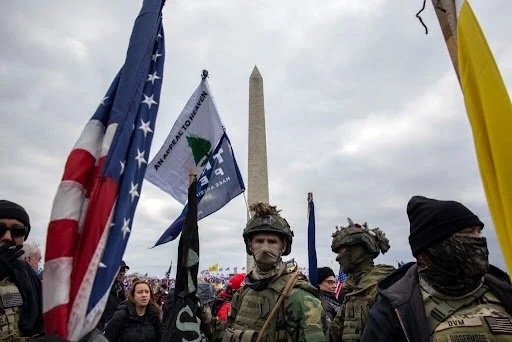
Officially, military uniforms signify distinct hierarchy, institutional membership, and a certain degree of sacrifice and responsibility. When the same visual language appears on the outfits of January 6th protesters or on an Edikted baby tee, the wearer is effectively able to pick and choose which militaristic associations to assimilate into their own brand and identity and which to avoid. This raises the question of whether these aesthetics may be a form of appropriation, romanticizing the violence of warfare without its often traumatic consequences. This position seems especially difficult to adopt given the popularity of these styles – it’s become unfair to accuse one celebrity, designer, or commercial outlet of disrespect when it seems like everyone is doing it. For fast fashion brands in particular, military references offer an easy way to capitalize on the aesthetics of utility, toughness, and rebellion, perpetuating an accessible trend almost entirely detached from its original contexts.
The popularity of military style has run parallel to a surge in the similar “Realtree” camouflage, the botanically patterned, hyper-realistic print traditionally reserved for hunting. Its cultural connotations are often quite regional — appearing, for instance, across my rural Vermont hometown as a subtle symbol of small-town pride, even for those who don’t hunt themselves.
The realtree aesthetic famously anchored Chappell Roan’s personal branding in 2023, printed with neon orange text on her “Midwest Princess” hat as a nod to her rural Missouri upbringing. In a (controversial) instance of political mimicry, the 2024 Harris-Walz presidential campaign released a nearly identical hat, designed to appeal simultaneously to the young, online demographic infatuated with Roan and to the down-to-earth, hunting type that may approve of Tim Walz’s “everyman” credentials.
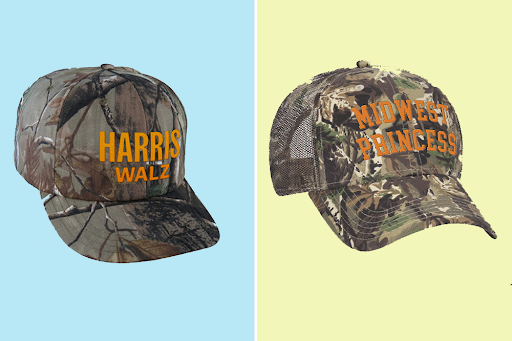
With its origins in hunting attire, Realtree camo has come to represent rugged individualism, a belief in personal liberties, and even an underlying lack of institutional trust. Furthermore, Realtree, alongside traditional military camouflage, is inherently a protective pattern. Louisa Rogers, an assistant professor of fashion communications at Northumbria University, told The Guardian that the popularity of the “survivalist” look “reflects that we’re experiencing anxiety as a society.” As economic instability, political polarization, international conflict, climate uncertainty, and the overwhelmingly accelerating presence of technology have made insecurity feel permanent in modern life, this argument feels particularly resonant. As Rogers argues, the survivalist aesthetic could represent a desire for personal agency in a world that feels increasingly uncontrollable.
But beyond a need for control and survival, camouflage could also imply a psychological desire to disappear or fit seamlessly into a crowd. In today’s political climate, this feeling becomes more literal as some individuals and families become increasingly afraid of seeking medical care, running daily errands, or stepping outside their homes at all due to fear of being targeted by ICE. These developments, alongside growing concerns surrounding corporate and governmental surveillance, could render the widespread adoption of camouflage a psychological effort to look and feel undetectable in plain sight. Ironically, however, as targeted communities genuinely attempt to stay invisible out of fear, the aesthetic of hiding has become trendy within a younger, more celebrity-focused demographic that actually wants to be seen. On one hand, this seems to entirely contradict the print’s intended purpose, but on another, the desire to participate in a major fashion trend is, in itself, its own type of camouflage.
Fashion has always had a complicated relationship with the things it borrows. In the past century, camouflage has been adopted by antiwar protesters, nationalist political groups, luxury designers, hip-hop artists, political campaigns, hunters, and ordinary consumers, alongside, of course, military personnel, who wear the pattern as part of a regulated uniform. Modern American culture has essentially declared military style unproblematic, and there’s very little reason to worry that camouflage, combat boots, or the like may reflect unfavorably on the wearer.
But as with most aspects of fashion, it's important to remember that a neutral is only truly neutral when we treat it that way. Although I have no intention of throwing away my favorite camo pants, I find it useful to consider the historical and modern-day interpretations and expressions of the pattern with an understanding that despite its ubiquity, our obsession with military wear may still say something about our societal priorities and anxieties.