Metamorphosis: The Album Era, or The Qualm of the Pop Star
[Spoilers for A24’s The Moment!]
On January 23, 2026, Aidan Zaminir’s film directorial debut, The Moment, premiered at the 2026 Sundance Film Festival. The mockumentary follows a semi-fictionalized version of British pop star Charli XCX as she comes to terms with the Brat summer phenomenon, the tetatonic shift it represented for her career, and what it means to finally be It.
Charli is no stranger to the public eye–for the longest time, most recognized her from an admittedly short string of conventional bubblegum pop singles from 2012’s “I Love It” to 2014’s “Boom Clap”. After that, her experimental sensibilities and abrasive flourishes, informed by her formative years in the London rave scene, led to the steady production of critically adored yet undoubtedly noncommercial output. For the longest time, Charli seemed content with the idea of being forever married to the underground, to the sticky floors and popper bottles of the tight venues she inhabited. But her fifth studio album, 2022’s Crash, proved otherwise. Featuring a more conventional pop production, Charli herself baptized it as her “major label sell-out" record. While her campaigning was fruitful– “I wanted to play this satirical role, so I was hypersexualizing myself, taking songs other people had written for me and using an A&R person for the first time in my career”– and Crash became her biggest commercial success by then, long-time fans found the reinvention an alienating and ill fit on an artist long-revered for her artistic integrity. In a now-deleted tweet, she shot back in the shape of a question: "Imagine if this entire album campaign was just a commentary on navigating the major label system and the sadistic nature of pop music as a whole?"
It’s all the more ironic, then, that her next album, the blaring electroclash beast of a record that just so happened to be the most authentic to Charli’s niche character and the most willing to shed light on the unglamorous deconstruction of a trashy partygirl, shot her into the stratosphere. With 2024’s Brat, Charli was no longer /mu/’s guilty pleasure or Stan Twitter’s princess of the underground– she was finally, officially and unabashedly, It. Brat led to Brat summer, a season of nauseating virality where the album cover’s puke green and arial font were consummated as one and consequently slapped over everything the eye could see, escalating by the day until it reached then-US Presidential candidate Kamala Harris’ desk.
This, precisely, is what The Moment seeks to dissect. The film satirizes this cultural moment of overzealousness, depicting the exploitation of Brat as it shed its original vision and morphed into something monstrous, something with horns and fangs and a hunger for cash–an era.
Approximately three months before the hatching of Brat, Charli indirectly endorsed that which would eventually trouble her: “I think a good artist always has to re-form, reformulate and reclothe themselves, quite literally”, she said to Billboard, in the same breath as she described the methods for her Crash metamorphosis. This, in summation, is the definition of an era: the album cycle in the language of pop stardom, and everything that resides in the external context of the actual music. By name alone, it indicates that each cycle must be its own moment, with demonstrations of versatility and change being primary modes of idol-making.
The Moment sees Charli choke in the face of the success she’s long-awaited for, cornered by label executives into continuing to construct what her virality set the groundwork for; Brat as a consumable experience to capitalize on, of party anthems and coke euphemisms, with a set dress-code and an attitude and a green filter over everything that will get washed away with the next album cycle. It’s here where Charli’s gripe lies, that which makes her one of the industry’s biggest contrarians: in her eyes, the series of metamorphoses (and the full-bodied devotionthese require) a pop star must commit are frequently exploitative, a rare instance where the necessity for change is actually limiting, and these expectations serve as contributors to the fragmentation and eventual erosion of the self.
Charli’s position is informed by over two decades in the industry, uniquely constructed from having spent years in the sidelines of nicheness instead of experiencing the straightforward trajectory of her peers. Her ideas turn paradoxically interesting when compounded with the fact that, despite its irreverence, Brat itself was brilliantly marketed and actually quite manicured. Artistically, it sees Charli indulging in experimentation–strategically, it saw her put all hands on deck when it comes to building up iconography. Knowing that the album cover’s supposedly “careless” design (whose easily replicable character turned inevitable viral sensation was swiftly capitalized on by Atlantic Records) took over five months to develop is enough to color The Moment and Charli herself differently. Not in a hypocritical way, but rather, in a way that lends her artistry more dimension than ever before.
All of this has opened the door for a wider extrospection of pop stardom and the modern-day consumer’s relationship with media. Through the waters of parasociability and alienation, change and regression, pop stars utilize the infrastructure of their eras to stabilize their legacy, shifting the weight and meaning of being It.
Let’s address the elephant in the room: we inevitably equate the glamour of pop with femininity. The genre, of course, wouldn’t be what it is today without 20th-century superstars such as Micheal Jackson, Elton John, and Prince, but nowadays it really wouldn’t be outrageous to say that the male pop star is an endangered species. Acts like The Weeknd and Harry Styles are certainly doing just fine holding up the fort, but notable output from female pop artists (see: Sabrina Carpenter) greatly outnumbers that of their male counterparts (see: Benson Boone). Regardless of gender disparities in other genres, pop is a woman’s game.
This, in turn, informs the way pop stars assimilate. Unironically, the habits of pop fanbases stand parallel to those of sports fans–collecting memorabilia, committing to tribalistic loyalty, and partaking in debates about personal GOATS. The latter in particular is representative of a peculiar behavior in pop fandom, where, given we’re talking about a mass-produced mass-consumed product, numbers and cultural impact are a major talking point amongst fans to the point where they’re regularly pitted against each other. Enter the main pop girl– the untouchable pop star, one who actively redefines stardom through cultural impact and effective use of iconography.
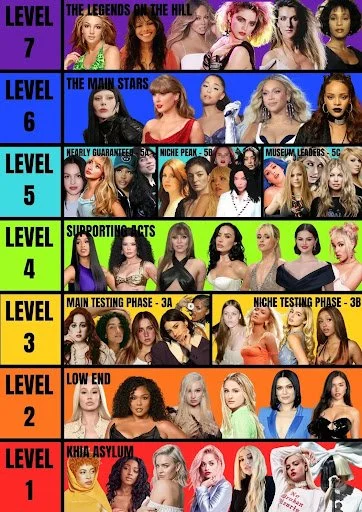
The pop girl hierarchy; a common conversation amongst fans, where pop stars are tiered with regard to their measured impact and career positionality.
Even where they objectively dominate, the apparatus surrounding female pop stars operates on a fundamentally different axis than the one governing their male counterparts. The music itself becomes almost incidental to the spectacle of the woman producing it; when she releases an album, the conversation extends beyond the music into an intricate audit of her presentation. Her aesthetic cohesion, her styling, and the metanarrative of her public persona are all expected to align to the degree of a digestible identity package. These expectations don’t come from nowhere—they're a reboot of a tried historical premise: a premise that the female form is communal property, malleable and negotiable, perpetually open to refinement, and subject to public examination that the male form is evidently not. The industry merely inherents this–the demand to perform beauty and intentionality even across the peripheral.
The immaculate era is therefore not a standard born from artistic rigor; it functions more like a tax, specifically levied on our female pop stars. But–you may think–if the methodology required to carry out an era is theoretically oppressive, as many have described it, why do they keep doing it?
Before we try answering that question, we must first know what it takes to strategize a successful era. The uncomplicated novelty of change is a good place to start–one that contemporaries such as Taylor Swift understand perfectly well.
The Eras Tour, Swift’s sixth concert tour, is the most literal example of this. Spanning almost 150 shows and collecting a record revenue of $2.077 billion with an attendance of over 10.1 million, the tour exists in the collective memory as a celebration of Swift’s musical eras and continued versatility. Its gargantuan, immeasurable success legitimized Swift’s legacy, solidifying her iconography and helping her build the ultimate bullet-proof brand. The teenage diarism of Fearless, slick theatrics of Reputation, blushing millennial kitsch of Lover, understated cottagecore of folklore–all and more compose a mosaic of Swift’s emotional expeditions over the years, each stage differentiated with their respective colors and atmospheres, pasted together with glitter and unchallenging warmth. Frequently framed as a “celebration of girlhood”, The Eras Tour saw Swift act not as subservient but in control of the system itself.
It’s all the more jarring, then, to see Charli close out The Moment by depicting her worst nightmare: a highly commercialized tour based off of the bastardized vision of Brat, complete with all the sparkles and manicured warmth of The Eras Tour. One could say that the horror lies in the incongruency between the hypothetical tour and Charli’s artistry, diluting the latter into a marketable PG13 fantasy, but the parallels are obvious. Charli has consistently posed herself as the “anti-Taylor” of the industry, expressing anxiety over the perils of the business that seem so ordinary to her contemporary in “Sympathy is a knife”. Tensions between the two quickly went off-the-rails with Swift’s cloying “Actually Romantic”; regardless, the argument still stands–in spite of its price, there’s an undeniable benefit to wearing the rhinestones and playing the part for so long.
This iteration of performing is not a talent but a skill, a muscle that Swift and other industry darlings of her prominence have exercised over the years. The anatomy of a truly compelling era (while mileage may vary between artists) is composed of three discernible factors: 1) Creative direction (aesthetic cohesion in promotional photoshoots/music videos/album visuals, such as Beyonce’s symbolically loaded Western direction for Cowboy Carter), 2) Marketing (brand sponsorships and endorsements, such as Sabrina Carpenter’s soft-serve campaigning for Short n’ Sweet), and 3) Extracurriculars (from positionality in the public eye, such as Lady Gaga’s outrageous looks for The Fame Monster and Artpop, to incidental contributors to an artist’s lore, such as Ariana Grande’s foray into acting and scandal during the Eternal Sunshine rollout).
This specific systemology, however, isn’t always enough. In a Substack entry, Charli characterized it as so: “Marketing and strategy and packaging and presentation can do its best to guide a viewer to the desired outcome but at the end of the day the consumer gets to decide whether a pop star is a symbol of sex, or anarchy or intelligence or whatever else they wish to see”.
Over the course of this article, I’ve used the term It, which is fairly ambiguous. Denoting cultural iconicity, to be It is a matter that changes by the day– the fall of the monoculture, poignantly orchestrated by the panopticon of contemporary algorithmic control, has dragged the mainstream along with it. This, in turn, has crafted an exceedingly hostile media landscape; no longer is there a solid mainstream against which cultural impact can be reliably measured. What constitutes “iconic” or even “good” has become a moving, deeply customized target, filtered through recommendation engines that keep consumers comfortably sealed in their micro-cultural bubbles, rarely if ever colliding with the experiences of audiences whose worldview and taste are meaningfully different.
An album can be a world-altering, seismic artistic feat to a million people and unknown to the next million; a pop star can be It to a hyperspecific population of individuals and entirely, painfully irrelevant to the rest of the world. In this media landscape, the concept of a cultural moment, an event, has become extraordinarily difficult to manufacture and nurture. Moments like Brat summer are rarer and shorter-lived than their predecessors, because the architecture of modern media has systematically eroded the collective attention span required to sustain them.
When moments become harder to craft organically, the pressure to engineer them artificially intensifies. Said pressure lands the heaviest on the women at the center of the machine; release cycles accelerate, albums shorten, and songs are constructed not around artistry, but around the four-to-six second window that could get picked up by an algorithm, the churn rate of the feed. Whatever sticks is what gets signed, sealed, delivered.
In this game of catch-up, artistry is the first casualty and the self is the second. The business model of the era demands that a female artist continuously remake herself: not as an act of organic, personal growth, but rather as an act of commercial survival on a schedule dictated by the appetite for novelty of the platforms she inhabits. Even Swift’s chameleon tendencies, while outwardly confident, often read less like boasts and more like structural descriptions of the specific violence layered in this metamorphic cycle. As such, The Moment reads as a candid inventory of what reinvention at scale actually requires of the self: a rejection of wholeness.