
8 Signs You Were Chinese in a Past Life
1. You take your shoes off in the house
2. You drink hot water
3. You like hot pot
4. You boil apples before eating them
5. You drink Molly Tea
6. You wear slippers indoors
7. @sherryxiiruii on TikTok told you you were
8. You own a Labubu
Take it from me, I’m Chinese in this life and I’ve done all of these! I’ve also had people pull their eyes back to mock my features, turn their noses away in disgust at my food at the cafeteria table, and make accusations about the type of meat my family’s restaurant was selling.
We’ve all seen the “You’ve met me at a very Chinese time of my life” videos, memes, and jokes across social media. Chinese summer, Chinamaxxing, Chinese baddies, and countless other variants have all spawned from the same trend. Some Chinese creators embraced the newfound interest in their culture by making long form videos introducing typical Chinese hacks and lifestyle trends like herbal teas to clear skin, traditional Chinese cuisine, and even sharing tips on learning the language. Perhaps for the first time in history, some Americans seem to be looking upon China with wide-eyed admiration and respect.
After years of sinophobia and western anti-Chinese propaganda, this movement is a refreshing wave of cultural appreciation for Americans and the Chinese diaspora. Chinese Americans were proud to share their previously forgotten and ridiculed culture. In particular, Tiktok user @sherryxiiruii was one of the pioneers of the “Chinese time of my life” trend. WIth 15 videos with over 1 million views each, with the highest being 6.3 million views and close to a million likes, she created a series that details how to become a “Chinese baddie.” Simultaneously, Americans marveled at Chinese technological advancements and the country's blend of traditional and modern lifestyles. What they were seeing through their screens wasn’t the oppressive, ruthless trade rivals nor the impoverished, brainwashed citizens American politicians warned of.
The “Chinese time of my life” trend perfectly coincided with growing dissatisfaction within the United States as more and more people saw through the smoke and mirrors of the American Dream. When the US government shut down TikTok in January 2025, American users moved in mass exodus to Xiaohongshu, or Red Note. There, they got a glimpse of the average Chinese citizen and their lives in China: affordable rent, clean and reliable public transportation, delicious and cheap food, and the same, silly everyday humor Americans enjoyed. Soon after, Tiktok returned to the US, and American users left Red Note just as quickly as they arrived.Nonetheless, a small seed of doubt in their preconceived notions of China had been planted. For some Americans, this doubt came with an earth-shattering realization: they’re just like us–no, they’re living better than us.
But what started as lighthearted amusement and genuine curiosity about Chinese culture quickly spiraled into a mockery and ridicule of the existence of over 1 billion people on this planet. And somewhere along the way, the very word “Chinese” became the punchline.
People weren’t curious about learning a new culture, they saw the engagement and virality of being Chinese and jumped at an opportunity to profit off the “Chinese time of my life” trend.
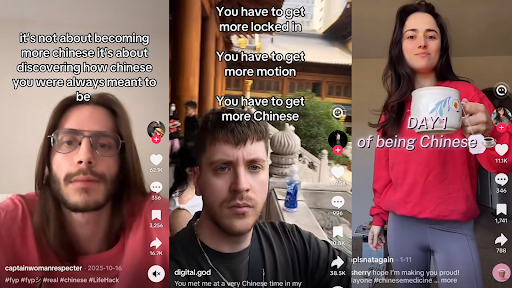
A few weeks ago, I stumbled upon a New York Times article about our “very Chinese time of our lives”, praying for a nuanced dissection of the subtle racism. Instead, I read through paragraphs and paragraphs of praise for this trend. I was confronted with the same casual nonchalance as every non-Chinese person who’s turned the culture into their own personal punchline.
One particular line stood out to me: “The meme is not bound by nationality or ethnicity; anyone can be Chinese if they wish. And right now, many do.”
“Anyone can be Chinese if they wish.” That one statement made my eye twitch. The dismantling of the Chinese identity into a child’s plaything, shiny and new and ready to be discarded by the next day, encapsulates the White indifference to their desire to conquer. It’s clearly cultural appropriation, but because it’s being “enjoyed”, it somehow becomes acceptable.
As a Chinese-American, I initially loved the “Chinese time of my life" trend. Seeing my culture being respected and celebrated on such a wide scale was something I once thought impossible. But as the trend strayed further and further away from respectful curiosity and wonder, my tongue filled with the same bitter taste as when I endured racial slurs being thrown at me. Six years ago at the height of the COVID-19 pandemic, when our elders were being attacked on the streets and pushed in front of trains, did you want to be in a Chinese time of your life? When the entire world pointed a crooked finger at us, who loaded their speech with vigor and hatred and slurs and laughed at our struggle and pain and the racism online? Was being Chinese fun then?
Being Chinese is not something I can simply stop doing one day. For the hundreds of thousands who laugh at the memes, enjoy the food, and start drinking hot water in the morning, these practices are as easy as trying on clothes. This week, you can try on being Chinese. Next week, when the newest trend hits the algorithm, you can bury it deep in your closet. This idea of enabling oneself to wear and discard cultures like clothing, discarding and forgetting it once the novelty wears off, is discussed by Bell Hooks in “Eating the Other.”
In 1992, Bell Hooks staunchly called out the cultural appropriation and commodification of ethnic cultures, especially of Black American culture by White people. The sudden obsession and ear participation in Chinese culture isn’t a unique phenomenon. It’s happened and continues to happen with African American culture. Ethnic cultures are viewed as “more exciting, more intense and more threatening” by White society. Hooks argues that by indulging in other cultures, White people distance themselves from whiteness so that they can later return to whiteness with greater intensity. In the early 2000s and 2010s, we saw teenagers emulating the style and speech of their favorite black rappers: fitted caps, oversized gold chains, and baggy jeans–originally and culturally black styles of fashion. Nowadays, they look back at that phase with slight embarrassment and laughter, thanking their lucky stars that now they’re normal.
But what makes the “Chinese time in my life” trend especially daunting is the fact that the trend is reactionary to the rise in power of right-wing politicians. The New York Times article quotes one interviewee who stated that her participation in the trend, namely by drinking hot water and eating congee, is “in a subtle way…more of an undercurrent — and to protest a government that doesn’t care about keeping people healthy.”
In this era of political strife, exercising the practices of your government’s biggest rival is protest. Bell Hooks categorizes this behavior as imperialist nostalgia; originally coined by Renato Rosaldo, Rosaldo defines the term as perpetrators of imperialism mourning the cultures and civilizations lost to colonization. Hooks, however, reframes the term to reflect contemporary structures where the perpetrators—White people in this case—take on a new form of imperialism in which their participation and consumption of ethnic cultures only exist to alleviate their guilt and wash themselves of the sins of their ancestors.
By allowing anyone to be Chinese, you allow White Americans to selectively absorb aspects of what they find enjoyable in the culture of a marginalized community. Simultaneously, they enjoy the privilege of maintaining the current status quo that keeps White people at the top of the racial hierarchy.
When such White people today enjoy and uplift ethnic cultures, they hope to clear their own conscience and have minorities look upon them with favor. It’s a way for them to protest the history of colonization and imperialism, to show that they don’t support their government’s actions.
This is exactly what so many Americans are doing: attempting to become Chinese, America’s biggest political opponent, to show their disdain for what the government is doing.
Cultural Appropriation vs Appreciation
Okay, but so what? It’s funny! It’s just a joke. That’s the thought process of so many Americans after Chinese Americans called out the clear cultural appropriation and growing racism of the “Chinese time of my life” trend.
Just because the trend seems to uplift and spotlight Chinese culture doesn’t mean it’s not cultural appropriation. In fact, it’s not even cultural appreciation. The Oxford Review defines cultural appreciation as going beyond merely adopting aspects of a culture, but also striving to understand and celebrate the significance of those elements within their historical and social contexts.
When you allow people to partake in a culture that’s not theirs without deconstructing their internal racism, it leads to a sense of entitlement and lack of respect for the original culture. To them, Chinese culture is the new shiny toy in their collection, the subject of a new wave of TikTok humor and engagement farming. Of all the people who’ve started calling themselves a Chinese baddie and drinking hot water, how many have actually started trying to learn Mandarin? Or is it the watered down, measly form of cultural appreciation that I should be thankful for?
“The simplified version of Chinese culture appeals to a non-Chinese audience, she added.”
Notice that keyword. Simplified. China is one of the oldest civilizations alive today, with thousands of years of history, culture, and traditions. Cherrypicking Chinese culture to find what aspects entertain the White audience is, in my opinion, textbook cultural appropriation. Watering down the culture to make it palatable to White audiences is exactly what the “Chinese time of my life" trend has devolved to. And once White audiences feel comfortable with the culture, they consume and adapt it for themselves.
That’s how we ended up with waves of non-Chinese people on TikTok “educating” the masses about Chinese New Year. Spouting nonsensical claims to not wear red (the signature lucky color), bemoaning not being able to wash their hair and other common superstitions we warn against, and complaining about their Chinese Zodiacs being unaesthetic. In the midst of them "becoming Chinese", they neglect the genuine values of the celebration: prosperity, gratitude, and family union. They’re unable to see beyond the physical, surface level traditions and practices to truly appreciate what Chinese New Year honors and the values of Chinese culture. Centering White experiences and opinions during the most important Chinese holiday that is rooted in centuries of tradition and history is nothing short of cultural and ethnic erasure.
Despite everything, I do believe that culture can and should be shared. It’s because I’m so proud of my culture that I want to share it with the world. Initially, the “Chinese time of my life” trend looked like it was setting the framework for how culture can be properly appreciated by outsiders. Then that went up in flames.
In a few short months, a new trend will take the internet by storm and the Chinese population will drop. And I will still be Chinese.