
A Look into J. Cole
For those who are unfamiliar with the hip hop industry, J. Cole (Jermaine Lamarr Cole) is a rapper from North Carolina. His album 2014 Forest Hills Drive is widely considered his most popular project, featuring hits such as “No Role Modelz” and “Wet Dreamz”. Beyond the music itself, what’s interesting is the role he occupies in the industry. He has built a brand around being a no-frills, humble artist, having gone platinum with no features.
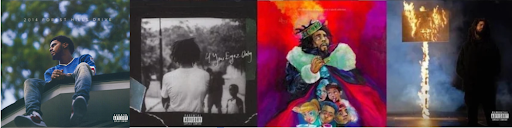
I regard J. Cole as my favorite rapper, though not necessarily my favorite artist overall, as I don’t have one in particular. There is a sharp distinction, in my opinion, between evaluating someone as a rapper versus evaluating them as an overall artist. By “favorite rapper,” I am referring strictly to the craft of rapping itself: flow, lyricism, cadence, and overall style. It does not take into account production, meaning the instrumental/beat-making side of a track; personally, that is not an area where he particularly stands out.
In other words, when isolating the art of rapping and storytelling, it is undeniable that J. Cole is one of the best in the hip-hop industry. His verses are intentional and clear, with his flow being versatile and technical. Some of his best flows are epitomized in songs like cLOUDs (just look at his rhyme scheme: "cLOUDs" rhyme scheme highlighted) and Snow on tha Bluff, which are personal favorites of mine. Hopefully, this freestyle will also convince you; I must come and revisit this clip ever so often: LA leakers freestyle. His strength lies in the way he constructs verses: clear, reflective, and purposeful, balancing technical skill with substance.
He can be labelled as a ‘conscious’ rapper, alongside artists like Kendrick Lamar and Freddie Gibbs, a subgenre of rap that goes a level beyond lyricism alone. Conscious rap prioritizes meaning and social awareness, overall, being introspective about the environment around you or internal struggles and growth; it is rap with soul. It is different from just being a good lyricist, as one could have the technical ability for impressive wordplay and clever rhyme scheme but still lack that level of introspection and authenticity.
I also think there’s an important distinction in hip-hop between what functions as mainstream entertainment and what leans more toward art. These categories aren’t mutually exclusive. There’s definitely overlap. Artists like Kendrick and J. Cole himself have songs that succeed commercially while still carrying meaning, like “No Role Modelz” or “HUMBLE.”
At the same time, the distinction is still noticeable. Some music is designed to be instantly digestible: high-energy, accessible, and perfect for shared environments like aux. On the other hand, there’s music that demands attention. It asks you to slow down and really listen to what is being said. That being said, I’m in no way suggesting that mainstream entertainment is inferior. Aux music consists more of mainstream hip-hop and pop, fascinating in its ability to immediately bring people together.
I recognise that there is definitely a time and place for certain music; in my opinion, J Cole is not the type of artist to be played on aux! His image reinforces this. He is known for his authenticity, straying away from the negative themes (ie, recurring themes of promiscuity, glorification of gang culture, all in all, embodiments of the phrase “fbgm” f*ck b*tches get money) that are often perpetuated in the hip hop world. Though critics have sometimes labeled him as boring or corny, citing his tendency to repeatedly critique and reflect on the state of the hip-hop industry.
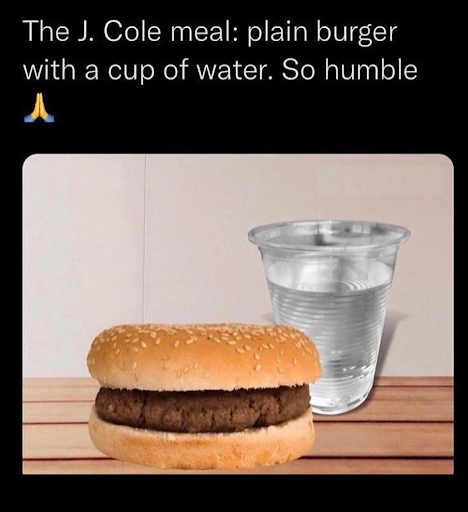
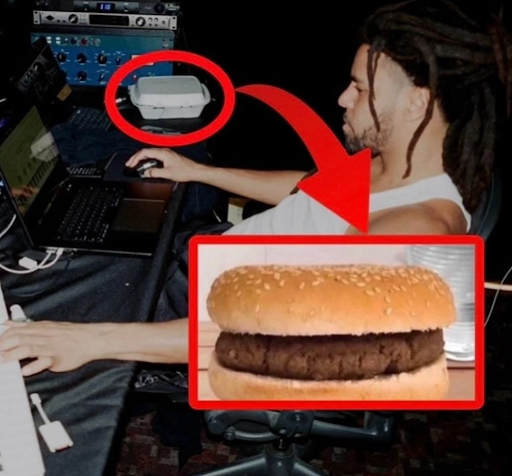
J. Cole has also become a recognizable presence in hip-hop meme culture, largely due to his down-to-earth public image. He is often associated with humility and simplicity, reflected in anecdotes such as the joking idea of a “J. Cole McDonald’s meal” consisting of a plain burger and water, as well as casual sightings of him biking or moving through everyday spaces without drawing attention to his celebrity status. Clowned on during the Kendrick and Drake beef for immediately pulling out of the drama and apologizing after releasing “7 Minute Drill”, a diss initially targeted towards Kendrick Lamar but quickly taken out of his album and removed from all streaming platforms.
The Album: “The Fall Off”
The Fall Off, released on February 6, 2026, is an album that has been teased for about 8 years, serving as the closing chapter of his overall story, coming full circle from his mixtape “The Come Up,” when he was still in the very early stages of his career. This is expected to be his last album, though he later clarified he is not retiring entirely; instead, this project marks the end of a certain phase, a large-scale narrative arc tied to the “J. Cole” persona, allowing for more creative freedom moving forward.
“The Fall Off” is a double-disc album, representing two distinct phases in his life; disc 29 detailing his life in his 20s and disc 39 offering a mature perspective. It serves as a prelude to his album “The Off-Season” (which is personally my favourite J Cole album as he explores and experiments with grittier flows). During an interview, J Cole elaborated upon the concept and intentions of this last album: “The title of that project, the first one that I would ever release, had a double meaning. There was the obvious one: my ambitions to "come up" in the rap game. The second was more subtle; my physical change of location to do so.”
Fun fact! He decided to release it on 2/6 as “2-6” is a nickname for his hometown, Fayetteville, North Carolina, further emphasising his intention to come full circle, recurring themes of honouring his roots.
A common criticism of the album is that it “didn’t live up to the hype.” But I find that reaction somewhat ironic, because it reflects the exact message J. Cole is exploring. The phrase “fall off” refers to a pattern that many of the greatest artists, athletes, and celebrities inevitably experience. It is unrealistic to believe they are going to be in their prime forever, and when that moment comes, people immediately react with criticism, saying Oh, he fell off', rather than recognizing that becoming famous in the first place is an extremely difficult level to reach. This reaction misunderstands the natural cycle of cultural relevance. Every generation eventually gives way to the next; younger artists rise as older ones move into a different stage of their careers. (taken from the narration in “The Fall Off” announcement video, another fun fact: the audio was taken from another podcast; it was not written by J Cole or his team)
