Project Hail Mary & The Art of Self-Sacrifice
SPOILERS FOR PROJECT HAIL MARY
In May 1986, just a few days after the Chornobyl Nuclear Disaster, Alexei Ananenko, Valeri Bespalov, and Boris Baranov, often today referred to as “The Suicide Squad” (not the DC group), were chosen for a mission they weren’t expected to survive.
The task was to go inside the rapidly melting, incredibly radioactive Chornobyl Nuclear Plant in an effort to find “a needle in a haystack” of a valve to drain roughly 5 million gallons of water from the plant’s basement. If this mission were to fail, a second, much more destructive explosion would have occurred, likely killing half of Europe and leaving a large portion of the continent uninhabitable for hundreds of thousands of years.
Nobody knew what could have happened to these men if they were to survive. Many believed that the three men faced a long, horrifically painful death following the mission, yet even with this knowledge, the men hunkered down and went inside, trudging through a knee-high pool of radioactive water. Even when their flashlights failed them in the darkness of the basement, they still pushed forward, successfully draining the water and saving the lives of millions across Europe.
All three of the men survived and, miraculously, went on to live long lives mainly unaffected by the plant’s radioactivity. Even so, when they entered the plant, nobody knew what sort of horrific health conditions the men would have faced afterward. But no matter the consequences, it was them or millions in Europe. What may seem to be a clear choice from an outside perspective is anything but clear from the perspective of those giving up their lives for the greater good.
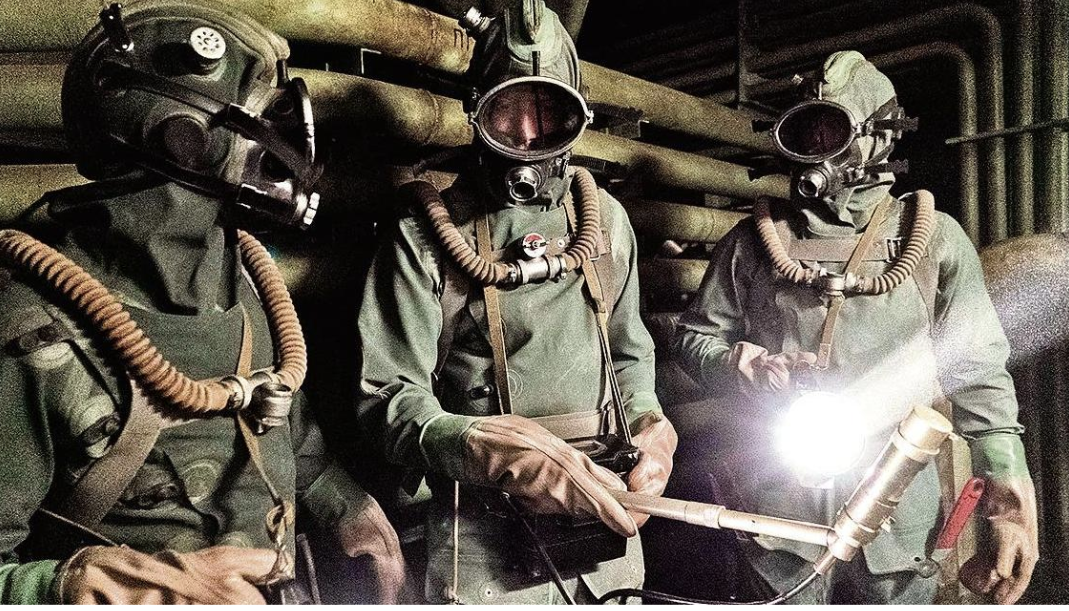
“The Suicide Squad” dramatized on HBO’s Chernobyl
Today, we see these men as heroes. But what makes a hero? History is filled with stories of men, women, and even children making the ultimate sacrifice for the agreed-upon “greater good,” and in Project Hail Mary, Ryland Grace, played by Ryan Gosling, must do the same to save the world, or more accurately, the stars. He’s been given the unique chance to be a hero to the entire world. The main problem: he doesn’t want to do it.
Project Hail Mary
Project Hail Mary follows Ryland Grace, a middle school teacher who becomes the world’s leading scientist on “astrophage,” a star-eating life-form spreading through the galaxy with no signs of stopping. We meet Ryland waking up on the ship, with no memory of how or why he got there. Yet, after putting together the pieces of his mission and with the help of a new alien friend, “Rocky,” whom he meets on this journey, Grace finds a solution and saves the planet from this galactic threat.
Throughout the film, we’re shown through flashbacks how Grace ends up in this predicament. While I won’t spoil every aspect of the film, what’s important is that after a freak accident wipes out the crew prepared for this mission, Grace is selected as the researcher to board this one-way trip. Yet knowing that in his lifetime, humankind will go extinct, the Earth may become uninhabitable, and that he has the power to possibly stop it, Grace refuses.
While many audience members know from the trailer that Grace was greatly opposed to the idea of going up from the start, the expected heroic arc would have him stepping up to the challenge upon realizing the responsibility he now has. Yet, after having time to give it thought, Grace still denies, and in turn, is drugged and forcibly put on the ship anyway.
‘Memento Mori’
Memento Mori, translated to “remember [that you have] to die,” is a Latin phrase known for its grounded approach to death. In philosophy, this phrase is not often used with the fear of death; instead, it’s used with the love of life. It’s used not to say that life’s meaningless due to its inevitable end, but instead the inverse: that every second of life is filled with meaning because one day it will end. Every second you spend alive should be spent with the thought not that you will die, but that tomorrow is not promised, and knowing that, you must live grateful for the present.
In Project Hail Mary, Grace is constantly reminded of this inevitable end. However, in his regular life, Grace is deeply unhappy. Due to his scientific past, he’s been shunned from the science community and forced to become a teacher to sustain himself. When a student asks him to explain the global threat, he tries to get out of it. When he is eventually approached by Eva Stratt, the leader of the Petrova Taskforce, a global initiative created to fight the Astrophage, he tries to run away, and when he is given a chance to save the planet, he still tries to hide.
Grace does not act out of virtue or bravery; instead, he acts out of a constant fear of failure and his mortality. Yet, despite this, he is our hero.
‘The Hero’
In stories across history, it’s often easy to determine who is the ‘hero’ and who is the ‘villain.’ Whether it be “Superman,” “Odysseus,” or “Rocky” (the boxer, not the alien), the hero is the one who chooses sacrifice, the one who, despite the fear of failure, fights forward anyway. But with this logic, Grace, who was forced into the situation and still tries to run away, wouldn’t be a hero.
What sets Ryland Grace apart is that he still does the right thing. Although the path to do so may be morally muddled, Grace, who’s been left alone with no personal gain from success, chooses to try anyway.
“What’s the difference between a hero and a coward? There ain’t no difference. Inside, they’re both exactly alike. Both scared of dying or getting hurt. But it’s what the hero does that makes him a hero. What the other guy doesn’t do that makes him a coward.”
The Bigger Picture
What makes you a hero is not why you do something, it’s what you do. What makes Ryland Grace a hero is that, despite his fear, he pushes forward. It’s highly probable that the three divers in Chornobyl didn’t want to put their lives on the line for a mission with the most disastrous consequences in failure. In a recent interview with The Times, one of the original divers even confirmed this:
“I was ordered to go there, so I went.”
The three men, a mechanical engineer, a senior engineer, and a shift supervisor, were chosen, similarly to Ryland Grace, for their knowledge of the matter and thus their higher probability of succeeding. They didn’t think of this mission as a choice; it was a duty they had to serve to save millions of lives. For Ryland Grace, in a way, he didn’t have a choice either. But in the end, the mission was complete, and they became our heroes.
In mid-2024, a couple of friends and I were standing outside of a Halal cart late at night. Joking around, I said, “Lamb with rice after a 2 am Bobst Library sesh hits” (word-for-word), which caught the attention of, who appeared to be, a homeless man standing a couple of feet away.
Surprised that I would be at the library at 2 am, he started a long (maybe 20-minute) lecture. Admittedly, due to the already late hour of the night, my main thought during the lecture was how we could step away without offending the man. While I don’t remember much, I remember being surprised at how well-researched the lecture was, and one thing the man said has stuck with me ever since:
“All of the work that you do, you do for the world.”
At the moment, I was struck by the beauty of the phrase, and he went on to explain that the hours you spend studying add to the world, as they will eventually be used to create and contribute something new. While a small statement in a long lecture of information, it helped remind me why I was, for example, hungry at Bobst at 2 am. I was there so that one day I could contribute something to the world, even if it was something small.
The statement didn’t make me feel as if I’d saved a cat from a tree, an old person from a raging fire, or a city from a galactic threat, but it did remind me that my time can be useful to the world, which, in a way, made me feel heroic.

The spot of the lecture as shown on Apple Maps
We’re not all Superman. For the vast majority of humanity, we will, hopefully, never have to be in a position similar to Ryland Grace or “The Suicide Squad.” But that doesn’t mean we can’t be heroes.
The reason Ryland Grace feels more relatable than a “Superman” or a “Rocky” is that his fear controls him, as ours often controls us. It’s much easier to wish to be strong, but when the going gets tough, the decision to give up feels all the more enticing. However, in the small victories where we don’t give up, where we push for just one more hour, we may just be heroes in our own way.
There are countless times in a day when you have the opportunity to be a hero to yourself or others, even if you have nothing to gain. These moments may be overlooked in our daily rush. But if Memento Mori tells us anything, it’s that we shouldn’t let these moments pass us by.
If it all has to end anyway, why not make the present a little more heroic?