What Bad Bunny Is Building: Cultural Power Without Assimilation
Bad Bunny didn’t rise to global fame by translating himself for a mainstream audience. Born Benito Antonio Martínez Ocasio, Bad Bunny is a Puerto Rican reggaeton artist who rose to fame in 2016 with his breakout single Diles, later solidifying his place in the Latin Trap genre with Soy Peor in 2017. His crossover into mainstream American audiences accelerated after his feature on Cardi B’s hit I Like It, alongside J Balvin, a song he later performed during the Super Bowl Halftime Show in 2020 with Jennifer Lopez and Shakira.
But reducing Bad Bunny’s rise to collaborations and streaming numbers misses the point entirely.
For years, he has been one of the most listened to artists globally, repeatedly topping Spotify charts and outperforming English-language acts, without diluting his Spanish lyrics or his Puerto Rican identity. In an industry that often demands assimilation for success among diverse audiences, Bad Bunny did the exact opposite. He made the world come to him.
That defiance became unmistakably political with the release of his newest album, Debí Tirar Más Fotos in January 2025. Widely regarded as his most culturally and politically impactful project to date, the album was created as both a love letter and a warning. It celebrates his Puerto Rican heritage while confronting the pressing issues of displacement: cultural erasure.
This cultural assertion carried into his historic recognition at the Grammy Awards, where his wins were widely understood not just as personal achievements, but as an acknowledgment of Spanish-language music as something that is central to global pop culture. In 2023, Bad Bunny made history as the first non-English-language artist to be nominated for album of the year. In 2026, he made history again by becoming the first non-English-language artist to win Album of the Year. Rather than signaling cultural conformity, the award marked a shift in power. We start to see the industry adapting to the artist, and not the other way around.
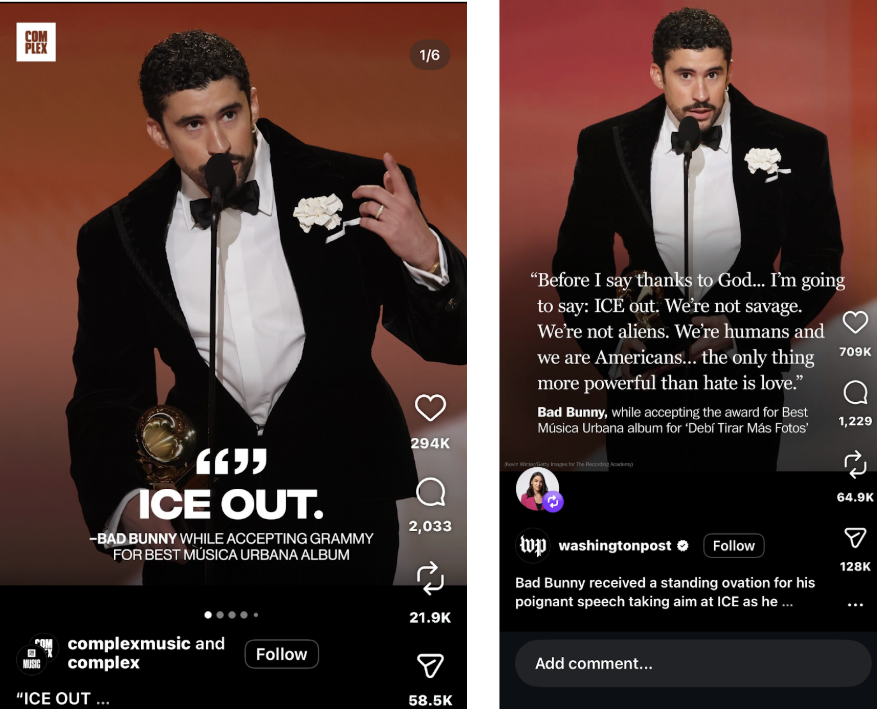
During his second win of the night, while accepting the award for Best Música Urbana Album, Bad Bunny used his speech to address the issues of ICE, immigration, and the urgent need to humanize the Latin American communities. He emphasized that immigrants are just as American and deserve a place in this country like everyone else. Within moments, his heartfelt words went viral, and quickly became a rallying cry across social media to highlight the inhumane treatment by immigration enforcement in the United States. He ended his speech with a powerful call to action: “The only thing more powerful than hate is love.” This message served as a reminder that, despite increasing polarization in the United States and around the world, love remains the force that can heal, unite us, and push us in the right direction.
His 2026 Super Bowl halftime performance, just a week later, further solidified this legacy. Instead of diluting himself or softening his message to appeal to a broader audience, he spotlighted Puerto Rican and Latin American culture exactly as it is. By emphasizing authenticity and representation, Bad Bunny demonstrated what global success can look like when assimilation is not up for negotiation. Every aspect of his halftime show, from start to finish, was layered with intention and symbolism. Here are just a few of the many meaningful elements from the performance:
Sugar Cane
At the start of the show, workers are seen harvesting sugar cane, which is a powerful symbol of colonial violence and labor exploitation in the Caribbean. This imagery nods to the communities forced to sustain capitalism and meet the global demand for sugar, yet who remained resilient in the face of oppression.
Lo Que Le Pasó a Hawaii
This song critiques displacement, gentrification, and the erasure of native culture. By inviting Ricky Martin to perform on such a massive stage, Bad Bunny connects local struggles to a global audience, emphasizing that colonialism’s effects are not just historical, but an ongoing reality for millions.
Toñita’s Caribbean Social Club
A renowned hub of Puerto Rican identity, music, and activism, the club stands for survival and cultural continuity beyond the island itself. Its inclusion in the halftime show reinforces the idea that Puerto Rican culture thrives across diasporic spaces, sustained by community and shared memory.
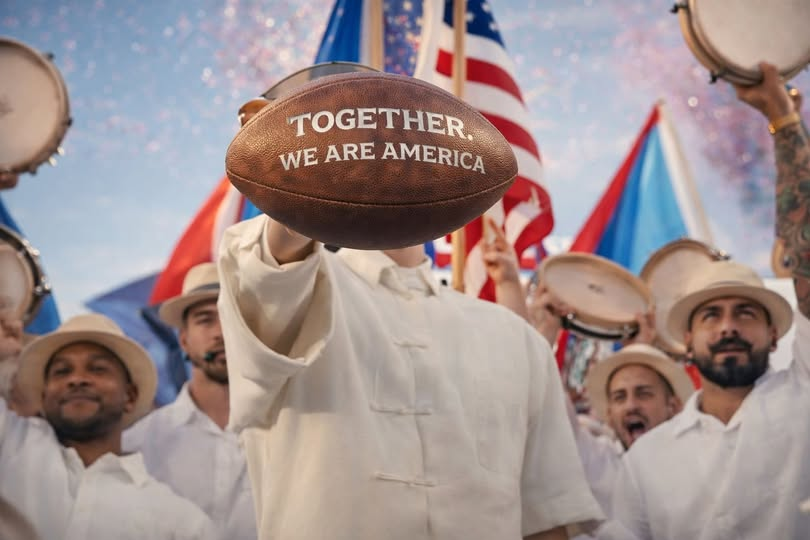
Together. We Are America
Bad Bunny closes his performance with “God Bless America,” followed by a parade of flags representing countries from South, Central, and North America. He begins with South American nations such as Chile and Venezuela, moves through Central America with countries like Panama and Honduras, and ends in North America with Mexico, the United States, and finally his home, Puerto Rico. By structuring the sequence from South to North, he symbolically centers regions that are often underrepresented in dominant U.S. narratives of “America.” This gesture reframes “America” not as a single nation, but as a collective of countries, cultures, and peoples. This final image reinforces his call for unity and love, while also reminding viewers that America is not singular. It will always be plural.