Online Gambling: The Realest Super Bowl Spectacle Ever
“I am putting 33 thousand dollars, which is every single dime that I have saved, on the Seattle Seahawks winning the Super Bowl,” is how TikTok creator DoykDela begins his now-viral video. In it, he is seen profusely sweating as he details his reasoning for such a high-stakes gamble. Today, the video has amassed 16 million views, 2 million likes, and over 44,000 comments, with many of the most popular ones criticizing his decision and suggesting he might have a gambling problem.
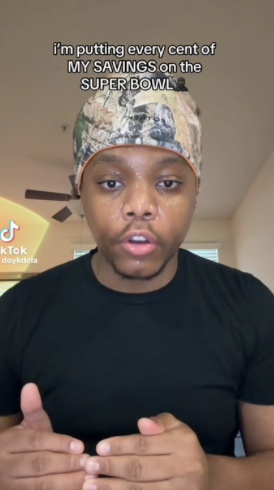
In the days leading up to the event, DoykDela posted updates to millions, describing how nervous yet confident he was in his bet. The 21-year-old explained that, as a lifelong Seahawks fan, he had always wanted to place a bet like this. He defended the decision by noting how he had been keeping up with the games and tracking the odds on the prediction-market app Kalshi, which listed the Seahawks as the overwhelming favorite to win.
As anticipation built, his wager evolved into a broader TikTok discourse, with users making their own reaction videos and offering commentary on what DoykDela described as the “biggest moment of [his] life.” Some echoed disapproval, others cheered the creator on for earning “easy money,” and many chimed in with humorous reenactments of how they’ll be watching the game on his behalf. The moment gained enough traction to catch the attention of another creator, who gifted DoykDela a ticket to attend the game in person.
To the relief of DoykDela, and the millions of Americans who bet on the Seahawks, the team secured the victory. On his $33,000 investment, he went on to receive a $49,000 pay out, resulting in a $16,000 net profit. This represents just a fraction of the $1.76 billion that was estimated to be bet on the Superbowl, a nearly 27 percent increase from the previous year (American Gaming Association).
DoykDela’s gamble generated fanfare from his anxious viewers, who posted celebratory memes, and he was reposted by major sports accounts across platforms. Yet, the victory did not exist in positive isolation. Amidst the humorous good-faith messages were comments and videos insinuating that his big win could lead him to make more five-figure bets, and potentially to addiction.
Whether celebration or scrutiny, this moment indicates how online betting is becoming widespread entertainment, even for those who do not watch sports. In many ways, DoykDela’s bet became its own event. It unfolded as a dramatic spectacle with destructive consequences, resonating within his viewers’ during a time of economic crisis in America. Like a modern-day game show, betting content creates a shared suspense that obscures the singular experience of losing everything you have.
More discreet forms of betting have long existed, but since its federal legalization in 2018, it has quickly become a very large part of digital recreation in the U.S., particularly among young men. Professional sports leagues and networks have further legitimized and encouraged fans to bet with paid advertisements running throughout the games, and betting platform sponsorships visible from any angle in a given arena.
Through platforms like FanDuel, DraftKings, Stake, and BetMGM, gambling has become so intertwined with digital and physical community spaces. From a cultural standpoint, it functions as a way for fans to assert their knowledge and authority over their favorite sports and teams. From an entertainment perspective, it literally increases fans’ investment in the games, thus raising the stakes and heightening attention. These factors become even more significant given the introduction to parlay betting, where micro-wagers for specific propositions are made.
While each person may be relying on independent parties for their betting tickets, what ultimately registers is a sense of community produced by the growing ubiquity and virtuality. It is not uncommon for individuals to use betting forums on Reddit or post to their social media accounts, updating on wins and losses.
On X, users celebrate finally hitting a big parlay or calling out an athlete for “selling it,” posting screenshots of the wager that got away. On TikTok, creators like DoykDela make humorous videos fantasizing about what they would do with their betting deposits, expressing frustration after a big loss, or celebrating being up. In these comment sections, individuals detail and poke fun at their endeavors and give tips for future bets, validating one another.
Financial loss is typically isolating, but within gambling culture it is gamified, rearticulating risk as play. Losses feel like temporary setbacks rather than material consequences. The comfort offered from this collective mindset prevents one from even recognizing if they are exhibiting signs of addiction.
For many young men sportsbetting brings them closer to the game and to one another, and advertising reinforces this connectedness. Referring to the 2025 NBA Championship, one Kalshi billboard read: “Your neighbour has $100 on OKC beating IND. Why don’t you? Join them on Kalshi.” This ad emphasizes spreading appeal within the audience’s own community and suggests that they will be missing out on something if they don’t place their bet.
Kalshi is distinctively referred to as a prediction market, differentiating itself from more regulated gambling apps. Despite this, they are effectively the same in practice. Beyond sportsbooks, this site broadens risk opportunities by allowing gamblers to bet on the odds that real-world events will occur– including outcomes related to elections, the economy, the weather, pop-culture media events, and much more.
This site similarly attracts young men, but the wider scope of betting potential and its framing as a prediction platform suggest the potential to widen its appeal to a more diverse demographic. Their infamous AI generated ad, which featured predominantly groups of elderly men and women, and college-aged women, indicates an effort to capture a larger audience.
Their latest influencer advertisements have received backlash as many TikTok users report seeing undisclosed ads on their timelines. In the videos, creators post screenshots of Kalshi prediction graphs and reference the site alongside a narrative of “easy” or “free money.” By making their recommendations feel personal, they play on the collectivist sentiments that reinforce betting as a common-sense social engagement. This contradicts the reality of overwhelmingly negative return rates that happen for the average individual on these sites.
Although DoykDela’s Kalshi bet resulted in profit, he later posted a reflective update detailing how gaining a significant amount of money in a short period of time had affected him mentally. He admitted that he initially felt tempted to continue gambling to sustain the engagement he had amassed, but quickly realized the downward spiral of that mindset.
Critique and public concern may have guided his reluctance to continue, but the engagement, humorous validation, and notions of far greater success he states were admittedly attractive. He goes on to say that his best course of action was to ground himself, suggesting that gambling could “ultimately ruin your life.”
Although his reflection did not garner the millions of views of his previous videos related to his betting saga, it remains important amidst online gambling community dynamics and the spectacle of high-risk bets. It showcases how the consequences of winning or losing are experienced independently. This is ultimately resistant to the growing narrative of collective gain and spectacle that is attractive to younger generations.
As gambling continues to emerge out of isolation and into ubiquitous recreation, it will be difficult to predict how early exposure will impact the millions of young people joining these platforms each year. In this era of the internet and digital economies, the future of gambling is unpredictable, but it is a safe bet that there will be apps to do exactly that.