Read This If You’re Lying About Your Top Four on Letterboxd
This year, I made it my New Year’s Resolution to watch one movie a day. While this may seem like a lofty goal (I’ll admit that I’m starting to fall behind), one thing keeps me on track. Logging movies on Letterboxd has become one of my true joys in media consumption. I get a rush of dopamine when opening the app, writing a snappy one liner for a review, and giving the film three and a half stars (can’t seem too eager). Somewhere, the most annoying person you know is nodding in agreement. Letterboxd has morphed beyond a simple way to log movies, and has instead transformed into its own form of social media. What started as a simple digital diary has turned into a high-stakes, competitive sport. Suddenly, we have become obsessed with not only our friends’ film-watching habits, but random Criterion Channel subscribers. As users and movie enjoyers, we need to return to the app’s core purpose: appreciating cinema.
Letterboxd is an online social media platform that allows users to log, rate, review, and curate films. Users can follow their friends, celebrities, critics, or industry talent on the app, creating a community of film enthusiasts across borders. Since the pandemic, the app has grown exponentially in popularity, rising from 1.8 million users in 2020 to 17 million in 2024. The app brings together a community of current and aspiring cinephiles. But, within any community come its conflicts.
Letterboxd has served as a new home for pretentious “film bros.” While these archetypes have existed since the first roll of film was ever played, the app has become a cesspool for long-winded reviews of 2001: Space Odyssey. This leads to users gradually feeling the need to sway their reviews or opinions to appeal to this stereotype. If one wants to appear “film literate,” they will feel more inclined to rate iconic movies highly. Not because they enjoyed it, but because it will make them look good.
One important feature is the ability for users to display their “Top Four” favorite films (for instance, mine are currently Good Will Hunting, Before Sunrise, The Worst Person in the World, and When Harry Met Sally). Many users overthink this selection while some switch out their favorites often. Recently, users online have been trying to pin down the perfect “Top Four” formula. For example, your profile needs one classic, one foreign, one comfort, and one silly movie. While creating this sort of guide can be helpful to spark inspiration (it really is impossible to pick only four films), it creates a sense of inauthenticity and sameness across profiles. It’s not as simple as just choosing our four favorite movies anymore.
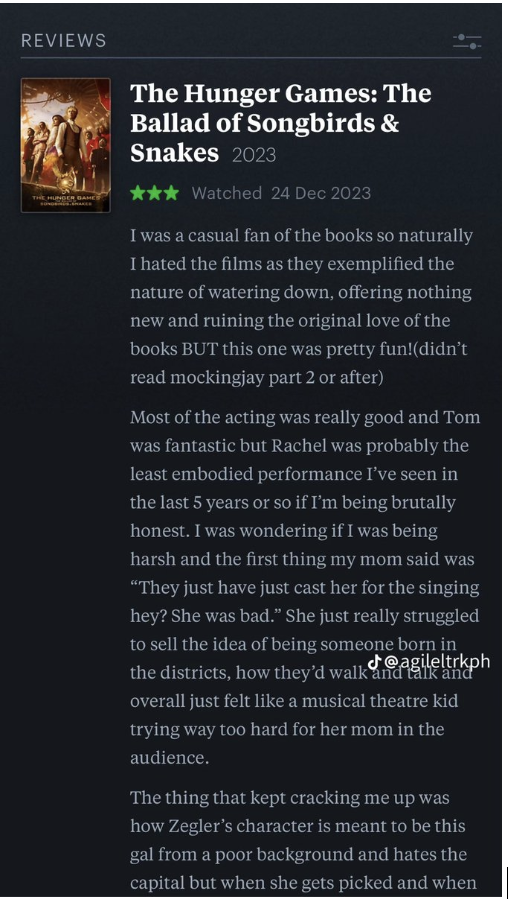
More and more people are succumbing to these online pressures. Actors Rachel Sennott, Ayo Edebiri, and Hudson Williams, have had public profiles on the platforms, some of their reviews sparking controversy online among fans. For example, Williams recently came under fire for a negative review of the latest Hunger Games film, The Ballad of Songbirds and Snakes where he ragged on Rachel Zegler’s performance. Most of the time these “controversial” takes are made before any real semblance of fame. What’s meant to be a fun way to talk about movies has become a reinforcement of the idea that a review is a public statement, ready to be scrutinized.
The addition of their “Year in Review” which operates similar to Apple Music Replay or Spotify Wrapped, allows users to see how many films they watched in the past year, how many hours they’ve logged, their top directors and actors, and more. Features such as this encourage competition amongst users. More and more people are watching films to increase the impressiveness of their profile, instead of their love of cinema and art. Tiktoks of people watching movies on a split screen with their homework just to seem cooler for having watched more movies have gone viral in the past few months.
Taking a step back, it’s important to remember why so many people have downloaded this app. Perhaps its greatest strength is its organization. It has created a streamlined way to see what films you have watched and what films you want to see. Compared to IMDB or a Notes app, the app makes it much easier to see your ratings and look back on reviews you’ve liked to remember how you felt about a film.
Additionally, Letterboxd’s introduction to the “Video Store” feature further expands the platform beyond simple logging. By allowing users to stream or rent film directly through the app, Letterboxd blurs the line between social media and distribution platform, deepening its role in shaping contemporary film culture.
Finally, Letterboxd and the film culture’s reemergence in the mainstream has made it easier to find recommendations from friends, critics, or industry professionals. From their presence on red carpets, asking celebrities their own “Top Four” to exploring random people’s niche lists of French Noir films, Letterboxd has been highly successful in bringing a wide variety of movies to light. This is especially helpful for smaller indie or foreign films that may otherwise go unnoticed in the media.