
That’s a Wrap: On Spotify Wrapped as Performative Culture and Data Collection
It’s December 3rd. You open Instagram instead of getting out of bed, absentmindedly tapping on someone’s story. The bright white contrasted by neon shades of red, green, and blue blind you. It’s a Spotify Wrapped. Story after story of flashing graphics sharing top artists, most streamed songs, top genres, and other listening data Spotify pools together for their yearly report flood your screen. You immediately swipe out of the app and go to your own Spotify. It’s Spotify Wrapped Day, and as a familiar song plays from the app, you’re already tapping through each story to find which covers to post.
Since their initial release in 2016, Spotify Wrapped has completely taken the world by storm. The yearly summary of each users’ top artists, their most streamed songs, their top genres, and more has become a spontaneous holiday that no one can predict but everyone awaits. In 2023, #SpotifyWrapped on Tiktok had 73.7B views; in 2022, the tag had 250 million views its first week. The year-in-review feature maintains six classic features, such as total minutes listened and top songs, as well as a few unique features that change every year. 2025 Spotify Wrapped users were given a Listening Age that compares their musical taste to other listeners’ in their age group. While Spotify Wrapped is a personal, individualistic report of one person’s music reports, it’s transformed into a communal act designed to be shared, compared, and commented on.
Everyone’s sharing their top artists, their most streamed songs, their top genres, their listening age, and more–and that means everyone’s Spotify Wrapped is open to judgement. The older your listening age, the more niche and cool and mysterious your music taste is; the younger your listening age, the more mainstream and generic your taste is. Spotify Wrapped is a competition for who’s got better taste, and we all contribute to it.
But what turns Spotify Wrapped into a badge of honor for having hundreds of thousands of minutes or a list of obscure artists is the data. Spotify Wrapped uses pure, objective numbers collected directly from the very app we use everyday. And who can argue with data? Anyone can post a Radiohead song on their Instagram notes, but very few are in the top 0.001% listeners of the band. The quantifiable measurement speaks louder than any words. For fans, it’s a symbol of dedication and loyalty to their favorite artist, evidence of being a real fan who’s poured their time into listening to their music. This year, Spotify even rolled out a “Fan Leaderboard" feature in which the top 100 listeners of an artist received their ranking and another story to reshare. The driving force behind the popularity of Spotify Wrapped is how it presents itself as an objective reflection of each user's music taste, and as consumers, we’re using music to prove our status. Simply put, people love labels; people love identities; people love to be able to categorize themselves in a community. And there’s no better way to prove you belong than through raw data. But do numbers really speak more than words? Can you really put all of the love and admiration you have for an artist into a simple statistic?
In Performing Differences, Jeroen de Kloet and Liesbet van Zoonen describe three dimensions of fandom: the cultural dimension, the performative dimension, and the local dimension. The cultural dimension addressed fandom as a serious study, questioning what fans do with their media obsessions and argued that people don’t passively absorb media, they take, use, and transform it. Through this, media, or music in our case, is shaped through the cultural norms of society and for the Western world, music is a reflection of individuality. Knowing that, the performative dimension, which they defined as how fandoms perform identity through repeated actions such as sharing, liking, and reposting, reveals how modern day fan culture is a desire for collectivism. With music, people perform the identity of a fan of an artist or genre by streaming the music. Spotify Wrapped exemplifies the performative dimension: fans participate in music streaming and sharing their Spotify Wrapped to affirm their identity. Their year-in-report is evidence of their identity; streaming your favorite artists for hours upon hours is how fans perform their fanhood. Sharing your Spotify Wrapped on your Instagram story is akin to announcing your fanhood to the world while taking note of fellow users who share your top artists. Spotify Wrapped allows fans to present irrefutable proof to back up their identity as a fan. You are what you listen to.
Even the artists, genres, and total minutes spent listening to music reveal the identity fans are carving for themselves. For some people, it’s a way to stand out against the crowd and highlight their individualism. While modern day fan culture has bred a hivemind of listeners, a counter-culture has arisen to oppose the dominant culture. Their condescending attitude towards mainstream music, especially pop music, has created elitist music listeners who think having a Spotify Wrapped populated by underground indie bands makes them superior to the average Sabrina Carpenter listener. We all know that one person who scoffs at what’s trending and only listens to unknown artists. They perform their identity in direct opposition to popular music by showcasing a Spotify Wrapped with obscure artists and genres.
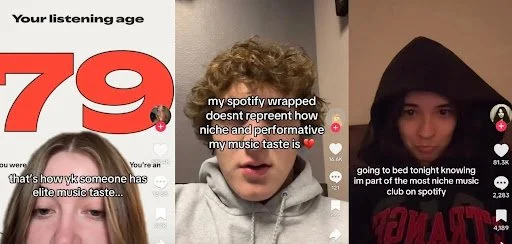
The popularity of Spotify Wrapped has inspired nearly every other company to follow suit in a yearly summary. Music streaming competitors like Apple Music and YouTube Music were the first to jump on the trend, but now every company is finding some sort of way to make their own version of a Spotify Wrapped. I’ve seen Beli, the food rating app, Discord, the messaging app, and Uber (both rides and food delivery) announcing their version of year-in-review feature. And it works every time. People are quick to click through the stories and share their reports online. With each campaign that goes viral, the more companies feel emboldened to join the trend. But here’s the catch: just exactly how much and what kind of data are these companies collecting? And what are they doing with that data afterwards?
The massive popularity of Spotify Wrapped and other data-based summaries in the same age as VPNs, private browsing, and data privacy is quite a paradox. Sure, Spotify knowing that I listened to Taylor Swift for 200,000 minutes is probably nothing compared to my IP address being sold by Google, but the willingness and understanding that our data is being collected is treated with such stark contrast. But what makes Spotify Wrapped so enticing is that it uses data, the seemingly most objective form of information, and transforms it into a perfumed wall of flashy videos and bright graphics. Us, as the user, aren’t considering what kind of data Spotify is collecting or what they’re doing with it, but instead, the masses are concerned about when the next Spotify Wrapped is coming out and what new features the company will be adding. Their extraction of our data is leveraged for Spotify Wrapped’s validity. With each company that joins in on this trend, the further and further our boundary for data collection is pushed.
Is the rise of yearly summaries just another result of late-stage capitalism? In order to collect our data, are companies masking their surveillance behind entertaining reports of our data? Or have we, after realizing the inevitability of data collection, resigned ourselves to the idea that we might as well extract something fun out of it?