Carrie Bradshaw Against The World
Audiences were first introduced to one Carrie Bradshaw in Candace Bushnell’s weekly column for The New York Observer in the mid 1990s. In it, Carrie was a recurring character through which Bushnell could divulge the details of her love life without directly incriminating herself. And so a heroine of chick-lit was born; Carrie was then given a face by Sarah Jessica Parker and shot into the modern canon with the 1998 premier of Sex and the City. The rest is history– the show would go on to accrue countless accolades and universal praise over its six-season span, permanently sealing its fate as a television classic. Carrie and her friends (Miranda, Charlotte, and Samantha) served as representations of the ever-liberated, ever-nuanced woman of the modern world as they navigated romance, friendship, and womanhood in the city that never sleeps.
Today, the show manages to both satiate our thirst for 90s nostalgia and carry itself with a distinctly contemporary character—one that immediately made it an outlier at the time of its release. Hence the Sex and the City revival we’re currently living in. When the world shut down in 2020, we all found ourselves with an unusually large amount of free time, wherein comfort shows like SATC were dredged back up into the cultural zeitgeist. Ever since then, Carrie Bradshaw as a concept has found a new medium to disrupt: the internet.
Here’s where things get a little complicated– it turns out Carrie’s bubblegum-pink, cosmopolitan-drenched, Manolo-Blanik-wearing essence doesn’t mesh all that well with current discourse. To some, she represents the most aggravating of New Yorkers; the privileged transplants, drivers of gentrification and diluters of the city. To others, she personifies the out-of-touch, anti-intellectual, half-hearted feminism of previous decades (making a comeback just now, by the way. Groundbreaking!), standing in for the commodification and continued minimization of women’s empowerment. These are legitimate grievances worth considering, especially given Carrie’s longstanding notoriety as a fictional character. However, there is one prevailing criticism of Carrie—one significantly less grave, yet still loaded regardless, that I have a gripe with.
Carrie Bradshaw is embarrassing.
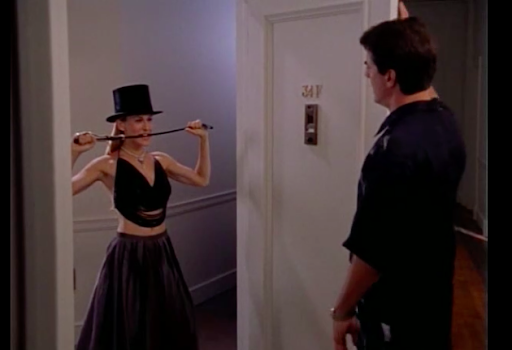
Right.
She constantly debases herself for the main object of her affections, the ever-revolting lover Mr. Big. In the big 2026 this sort of lovesick, off-the-wall behavior is consistently framed as what it always was: pathetic. It’s something that has earned her plenty of revisionist vitriol, particularly when said lovesickness soured her relationships with the women around her and therefore implicated one of the main strengths of the show. For all its support of women’s sexual and financial independence, Sex and the City’s portrayal of Carrie wasn’t all that liberated. Instead, she’s tethered to a love that was, for almost the entire lifespan of the franchise, unreciprocated.
Most jabs at Carrie’s character stem from this line of thinking–bratty, delusional, and foolishly girlish in a way that grows increasingly grating once you remember the grit with which she debuted in the show’s comparatively grounded pilot. I want to clarify this isn’t quite where my gripe lies just yet; in fact, I agree with all of these sentiments as if they’re my own. I was never fond of any of Carrie’s affairs, much less of Big, and during many rewatches I’ve been consistently baffled by her erratic decision-making. But I couldn’t tear my eyes away, like I was watching a sequin-wearing trainwreck or pedestrian squabble in Union Square.
Carrie Bradshaw being imperfect and perpetually embarrassing is factual. But contrary to popular belief, these are not crimes. Carrie Bradshaw being a bad character because of said embarrassing factor is a calculated misreading of the text, and simply not true. I’m not going to pretend as though the showrunners handled her character and development perfectly (they did not), but what audiences did receive in the end is an incidentally masterful depiction of a modern woman with enough disposable income and complex interiority to embody what past women were never allowed to be: a hot mess.
In this regard, current audiences are shown to side more with either the righteously prudish Charlotte or the radically liberated Samantha (Miranda, my second favorite, is perhaps still too much of an acquired taste, even more so than Carrie). Both characters are bestowed with the gift of not being the main character of the show, making it considerably more difficult to point out their flaws. As such, they’re much more impersonal and therefore much more palatable than their protagonic counterpart. Carrie Bradshaw, for all her faults, is a mirror of the watcher in the same way she was of Candace Bushnell during her column days. It’s why we find such offense in her fumbles and missteps; the show’s framing is deliberately intimate, arguably meant to encourage this exact emotional response of taking on her embarrassment as our own. Each episode is framed by Carrie’s narration as she writes for her own column, simultaneously speaking to the person on the other side of the screen as if the audience itself is the fifth woman of the friend group.
Perhaps we’d like Carrie if we knew less of Carrie, then. Most of the time, shame comes from something crossing over the increasingly-blurred boundaries between the interior and the exterior. There’s shame in letting others take in the unsightliness of our insides and there’s shame in seeing others do this for themselves, but it’s only through such exposure to shame that one can overcome the self-imposed barriers of the human mind. But in the meantime, this fear of shame permeates our every thought, and our uncomfortability with earnestness leads us to shut down sentiments similar to what Carrie Bradshaw as a concept represents.
Essentially, to be embarrassing—particularly in the field of romance—is a fate worse than death. To quote HAIM’s “ Relationships”, which went platinum precisely nowhere outside of my room, “I think I'm in love, but I can't stand fuckin' relationships / (...) I think I'm in love, so why am I trying to escape from it?”
The modern dating scene has consistently been framed as “bleak”. Eerily manicured dating apps, popular media setting audiences up for failure through distorted depictions of “the one”, growing social disparities, and increasing tensions in the battle of the sexes has made modern love all the more fraught. It’s mortifying to open up nowadays, making it all the more easy to run from intimacy. To retain any semblance of dignity, we’re encouraged to cling to the performance of cool and just… hope something happens. Numbness, informed by world-weary cynicism and an all-encompassing awareness of the self in relation to the outside world, comes to some more easily than most.
This is further substantiated by the fact that we’re at a very interesting point in time where love is, purely based on cold-blooded technicality, no longer a necessity. Companionship is, and will always physiologically be, but romantic partnerships as we know them aren’t as life-or-death as they used to be. The institution of marriage has been perpetuated by countless politically-motivated and financially-incentiviced unions throughout history, where a man’s social capital was dependent on the weight of his estate and a woman’s was entirely dictated by the aforementioned man. While we still haven’t secured unanimous egalitarianism between both parties, we have made an effort to reframe marriage as a matter of choice. This, coupled with our growing understanding of human sexuality and the fluidity that lies past the binary, has made commitment all the more easy to thoughtfully ruminate on. This is undoubtedly a net-positive—it just happens to come at a time where seeking companionship is erroneously framed as a battle not worth undertaking.
We’ve festered in this epidemic of nonchalance for a while now, and while there appears to be a growing sense of resentment towards this poorly put-on act of apathy, most are still held back by their own crucifixion at the slightest chance of humiliation. But paradoxically–and I hate to break this to you, truly–romance is the one field where embarrassment is required for any sort of progression.
Returning to Carrie; she’s embarrassing because she throws herself at romance whole-heartedly. To her, it’s an all-encompassing affair, a full-bodied experience implicating all sense and sensibility. Therein lies the hamartia of her character, the tragic flaw that consistently leads to both her inevitable demises in-universe and the disconnect between her and contemporary audiences. I truly believe that she was never meant to be a realistic depiction of a New Yorker, or of a human being at all. Rather, she functions as a comically hyperbolic yet refreshingly authentic depiction of one’s most humiliatingly earnest strides in love.
…And just like that, Carrie Bradshaw is nowhere close to being a role model, or a perfect woman, much less a perfect friend or perfect lover. But what she is is palpably, monstrously, and embarrassingly real.