We’ve Lost the Plot on Thrifting
The word “Thrift” is derived from the Old Scandinavian word “Thrifta,” meaning to prosper. Scandinavians faced brutal winters, and harvest destruction threatened to leave many starving. To use thrift as a descriptor was for those who survived despite these challenges, in a “condition of one who thrives.” It was only around 1520 when thrift adopted its more modern meaning of “saving.” To thrift was to save, and that’s what poverty-stricken communities did. Disadvantaged communities flocked to thrift stores to save money on clothes. But are people saving when a beat-up pair of Doc Martens is bearing a handwritten ‘$70’ at a curated resale shop? Are newly-immigrated individuals expected to buy a pair of $30 jean shorts off Depop, or should they send an offer first? Surely not. The dichotomy between a Salvation Army and a boutique resale shop is characteristic of an increasingly significant societal shift: the popularization of secondhand shopping. Many impoverished families dreaded the connotation of thrifting, akin to being on public assistance. But now, we’ve created a new connotation tied to individualism.
This shift towards shopping secondhand has its roots in social media culture. Social media content creators have pushed towards circular shopping habits as a way of obtaining a distinctive outfit. Creators, like Ashley Bestdressed, who boasts millions of subscribers, are some of the forerunners of this cultural movement. She was influential in associating with shifting the intent of thrifting in the early 2020s, with her YouTube channel boasting over three million subscribers. Ashley’s decision to wear entirely thrifted outfits during New York Fashion Week in 2020, for example, associated used clothing with high-profile settings. This newfound visibility on social media introduced the motivation to emulate the distinctiveness of similar beloved creators. The result is secondhand shopping as a primarily individualizing tool rather than an economic one. What was a genuinely good way of saving money became familiarized with a broader population that’s increasingly frugal amid the rising cost of living.

A sample video thumbnail by Ashley
This habituation to secondhand clothing coincides with the collective realization that fast-fashion clothing is shoddy. Of course, this also aligns with the start of the COVID-19 pandemic and the rise of online consumption as a social norm. In this lies the rise of resale platforms, like Depop and ThredUp. The convenience these platforms provided pervaded the original intent of shopping secondhand when it wasn’t possible to do so in real life, allowing for their long-term integration in Gen Z culture. Such platforms make thrifting frictionless, but also surprisingly social: anyone can list their antiquated clothing at no cost. Since 2020, thrifting has attempted to meet the demand of already existing disadvantaged communities, the emerging Generation Z, and the broader population who are thrifting as a fallback from the failure of fast fashion.
Charitable organizations originally founded thrift stores in the early 20th century to make affordable goods available to low-income individuals, an option for people without options. Goodwill and The Salvation Army spearheaded a circular business model, in which people could donate their excess goods, resell them at an affordable price, and the profits would go to charity. Various communities were served by these early thrift stores. Needy families, the number of which increased after the economic conditions following the Great Depression, utilized thrift stores to refresh their homes and wardrobes. Thrift stores also alleviated the guilt upper-class women held about their shopping behaviors by letting them donate surplus clothing.
Beyond the needy, thrifting also served the historically excluded. Artists and the LGBTQ+ communities found freedom to self-express through thrifting. Many incorporated discarded materials into their looks as a critique of art commercialization. Queer filmmaker Jack Smith is considered a pioneer of the “Trash Aesthetic,” often sourcing secondhand goods for costume and set design. This aesthetic became a template for creativity by employing secondhand clothing as emblems for rebellion and avant-garde expression.
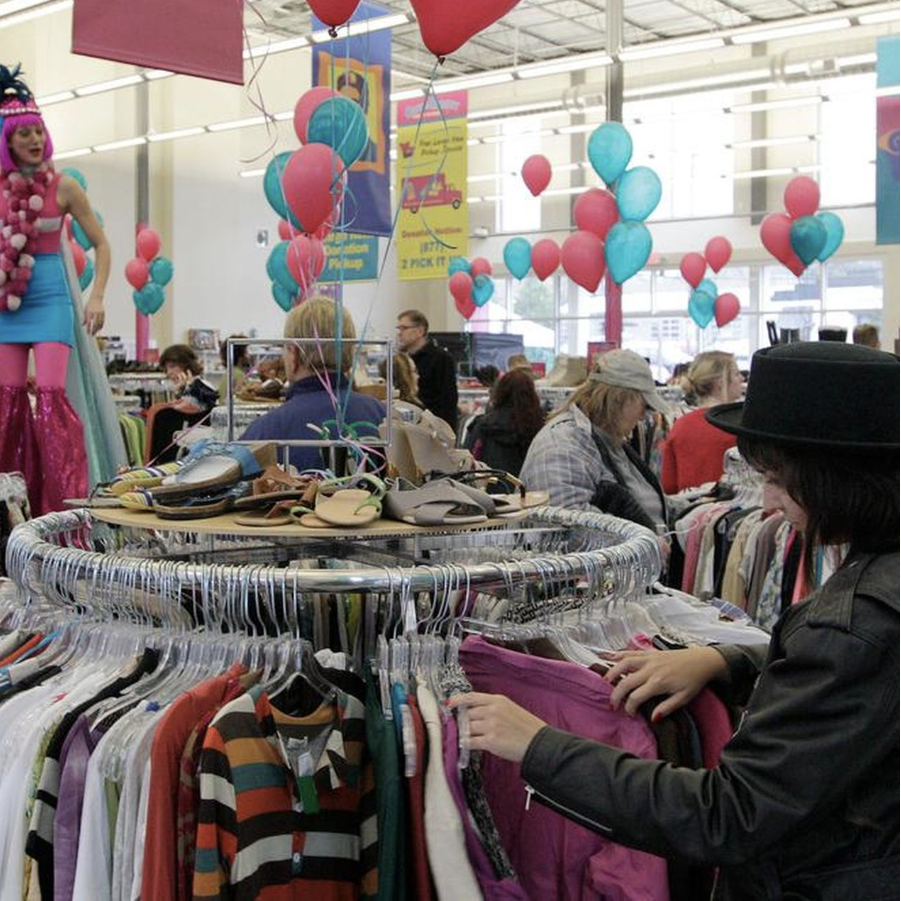
It’s this rich history that must be taken into account when evaluating how problematic the thrifting gentrification is. With this history in mind, fast forward to the turn of the 21st century, and we witness the rise of thrift store chic, a style that emulated the shabby and uncoordinated looks of many rock stars at the time. Succeeding this is the rise of vintage clothing, popularized by shows like Sex and the City, which featured secondhand shopping as a way of obtaining unique articles of clothing.
And of course, we can’t forget the later thrift rise facilitated by digital platforms. The COVID-19 pandemic accelerated the shift toward eco-conscious consumers. Platforms like Depop and Vinted empowered individuals to become sellers as a means of contributing to a circular economy and sustainable shopping habits. But arguably, in the process of appealing to the youthful Gen Z, these digital reselling platforms aestheticized and financialized the whole practice. Searching for “Depop” on YouTube yields hundreds of results on how to become a top seller on the platform. Likewise, searching for “vintage” on these secondhand sites returns thousands of results — and it doesn’t take more than a quick scroll to see how watered down that term has become. These are telltale signs of the industrialization thrifting has undergone. Flippers see a formerly necessity-driven audience become overshadowed by a new public that can afford their higher price points. This microcosm of buying low and selling high has even extended into the practices of some aforementioned charity shops, with Goodwill applying price-discriminatory layouts in some stores, most notably, a dual-floor store in Santa Monica that charges significantly more on the upper floor. What began as an essential for some has perhaps lost its original purpose.

A typical result when searching for “Depop” on YouTube
Faced with this, one can’t help but feel that we’ve regressed to thrifting’s Scandinavian origin: meant for those who were thriving. Now, that isn’t to say that we should completely abandon thrifting or demonize those who’ve thrifted unnecessarily — I’ve sent my fair share of lowball offers on Depop. Rather, we should restructure our relationship with secondhand shopping. Firstly, we should rethink why we’re thrifting and humble ourselves. Thrifting for sustainability, your budget, or aesthetics are all valid motivators. But if your final verdict is to thrift for fun, then you should at least not claim a moral high ground you haven’t truly earned. Buying thrift store inventory with the intention of flipping it at an exorbitant markup is undoubtedly out of the question; that’s different from just occasionally selling items you no longer wear. Next, we should at least prioritize stores that are mission-driven. Salvation Army, Goodwill, and local charity shops have their profits go toward a common good, as opposed to commercial resale shops. Finally, and arguably most importantly, leave room. Literally. If you’re comfortably middle-class, you shouldn’t be shopping at a thrift store in a low-income neighborhood, or at “the Goodwill bins.” An eBay storefront specializing in vintage clothing is better suited.
No one should feel guilty for thrifting, but we should consider the context we’re in when determining the ethics of it. It's an uncomfortable truth, but some people, especially those who don’t need to, should do less of it — or redirect to price points that don’t compete with necessity shoppers. Then, perhaps, we will thrift in a way that aligns with the values we claim to hold.