Amidst the great cinematic run of 2026, September saw the release of two standout films just a week apart: Resident Evil, an action-packed adaptation of the survival horror video game franchise, and Primetime, a punchy psychological thriller about American television personality Chris Hansen and his NBC reality series, To Catch a Predator. Lead performances by Austin Abrams and Skyler Gisondo were highlights of both films, with the two former child actors receiving the overdue flowers they deserve.
In both Resident Evil and Primetime, Abrams and Gisondo alike portray the quintessential everyman– someone who stumbles over their words, trips over thin air, and is probably acne prone. Yet, the awkward, clumsy nature of these characters is exactly what charms audiences. A recurring sentiment in online discourse, particularly in the comments of TikTok edits featuring the actors, is that these characters feel familiar– like a next-door neighbor or someone they used to go to school with. In one edit centered on both actors, @m4r!3 commented, “Challengers if it was about workers at a trampoline park instead of tennis.” In another edit, @victimsofthemodernage described Gisondo as “that one camp counselor that you were lowk[ey] in love with.” The recent enamoration with the remarkably ordinary leading man is hardly serendipitous. In an interview with Entertainment Tonight, Resident Evil filmmaker Zach Cregger admitted, rather bluntly, “I don’t want any hot people” for this movie, aiming for more “gritty” and less “glossy” actors.
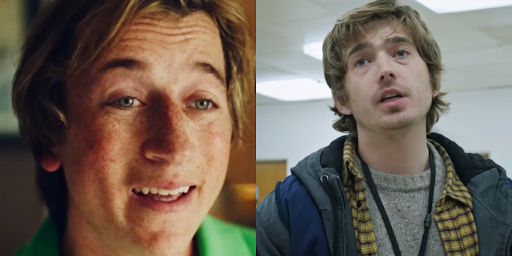
Skyler Gisondo as Decoy Dan in Primetime (X/@Lulamaybelle) and Austin Abrams as Bryan (Sony Pictures)
The direct effect of more grit and less gloss is friction: a sort of tension, when everything is laid bare, flaws and all, audiences hold their breath and keep their eyes glued to the screen. This explains why people feel such affection, and even a sense of protectiveness toward, Bryan (Austin Abrams) in Resident Evil as he lies crying on the garage floor, stomach out, infected and all alone in Racoon City, as well as Decoy Dan (Skyler Gisondo) in Primetime as he falters through his lines on television, finally managing to spit out he’s a “profreshionally” trained actor to the predator. This friction– imperfection, vulnerability, doubt – is at the core of the human condition, grounding even the most outlandish scenarios in reality and making them recognizable to so many different people. At the end of the day, these characters aren’t carrying out glamorous fairytale fantasies. Bryan is a tired medical courier who takes the most unfortunate midnight delivery job to get double pay and Decoy Dan is a struggling actor who sees his gig with NBC as a stepping stone to obtaining SAG-card actor worthy status. Bryan and Decoy Dan are situated in real life, subjected to misfortune, uncertainty, and hardship just like everyone else.
The itch for visual imperfection, both from within the industry and outside, feels like an instinctive rejection of the cookie-cutter perfectionism Hollywood has long gravitated toward. Beyond the film industry, the world seems to be reckoning with artificiality– what is real or not, true or untrue, authentic or fabricated. The inclination to root for actors like Abrams and Gisondo– survivors of “influencer face”– points to a resistance to the tides of the 2020s, what with the perfectionism pandemic, the normalization of GLP-1 skinny, and the generative AI revolution. Favoring the real, imperfect, and textured performances over the sleek, synthetic, and predictable starts to feel like something deeper. Such a choice reflects an affinity for relatability and personability, but more broadly, it’s a stance against standardization and unhealthy aestheticism.
Furthermore, the film industry’s greatest affliction right now is its recycling of the same actors and IP (including Resident Evil itself), a glaring symptom of creative stagnation and risk-averse complacency. Movie studios historically have opted for sequels, prequels, and remakes; the pandemic saw theatrical releases (and movie releases in general) take a blow, only pushing studios to stick to what they know: that existing characters, stories, and movie stars are where the money is. This strategy remains unchanging during post-pandemic years; CNBC reported that in 2025, between 50% and 70% of the movies from the six major studios (Universal, Disney, Warner Bros, Paramount, Sony, and Lionsgate) were related to existing IP. However, the downside to the well-oiled Hollywood machine (which is harder to capture in numbers) is the absence of novelty, nuance, and friction in film. Seeing Kidman, Hathaway, and Pattinson in every other movie trailer at the cinema or hearing an announcement that yet another reboot is in the making, warrants, at the very least, a deep sigh. Conversely, it’s refreshing to watch new faces on the big screen, like Inde Navarrette from Obsession, or independently produced films succeed, like Fjord taking home the Palme d’Or at the Cannes Film Festival.
One consoling perspective is that the good fight for experimentation and humanity in media has been a recurring discussion over the decades, one that each generation must contend with anew. Former NBC president Sylvester “Pat” Weaver created the initiative “Operation Frontal Lobes” in the 1950s to promote intellectually stimulating television and champion the medium’s potential to educate, enlighten, and enrich the public. Around the same time, American screenwriter Paddy Chayefsky argued that dramatic truth lay in portraying “the marvelous world of the ordinary” and the “commonest people” who think, look, act, and feel like those around them. Over the past several years, distribution companies like A24 and NEON have formed a loyal following by funding original movies. Time and time again, grit wins over gloss. It’s reassuring to see that, over the years, the public keeps returning to art that champions creativity, human ideas, and real stories with real people.