What do you believe??
A bit of a loaded question to confront someone with, and an extremely difficult one to answer. Some believe it to be an impossible one. Does anyone have completely personal views, independent of outside influence? Most likely, no.
We live in such a stimulating world, that having a secluded space to create, develop and back stable, first principle beliefs is quite rare. The screens on our phones, on billboards, on televisions and on movie screens incessantly preach rhetoric that seems to be fusing with our own brains and ideas. We interact with so many different people everyday, both in person and online, that our reactions to the world around us serve as the blocking of our day, weeks, and lives, rather than our own desires and needs. These external interactions cause internal reactions that fuel our identities. Our belief systems. To act on principle, and not in response to friends, enemies, family members, teachers or politicians, seems far from reality. You would immediately be an outlier. And nobody wants that.

The term schismogenesis was first coined in 1935 by the late and great sociologist Gregory Bateson, who described it as the creation of division and differentiation through interaction. Unlike mimesis, which relies on copying in response to an outside world, Bateson proposes that being around other people creates a schism (the first half of schismogenesis) rather than unity or hegemony.
The easiest way to feel a sense of belonging is to locate an other. To hold a group together, not by common ground, but by a common difference. This is quite similar to becoming friends with someone because you found out you both hate the same person, not genuine connection or spark. You have strengthened the relational bond by identifying an other and generating a common ideology around it. Bateson claims that it is not the content of people’s beliefs that create difference, but the desire to have differentiation between groups.
This can theoretically be seen in the increased politicization of our country, particularly in the rise of Republican extremism. I often find myself wondering how previously standard Republican party members find themselves teetering on the edge of objective fascism, but with schismogenesis, the answer becomes clear. The increased division among citizens creates an incredibly strong sense of belonging within their respective parties, causing them to reinforce the values of the party and further entrench themselves within the alleged “community.” Humanity is an innately social and categorical society, relying on interaction to survive. The loneliness epidemic accelerated by the rise of the internet has driven depression rates through the roof.
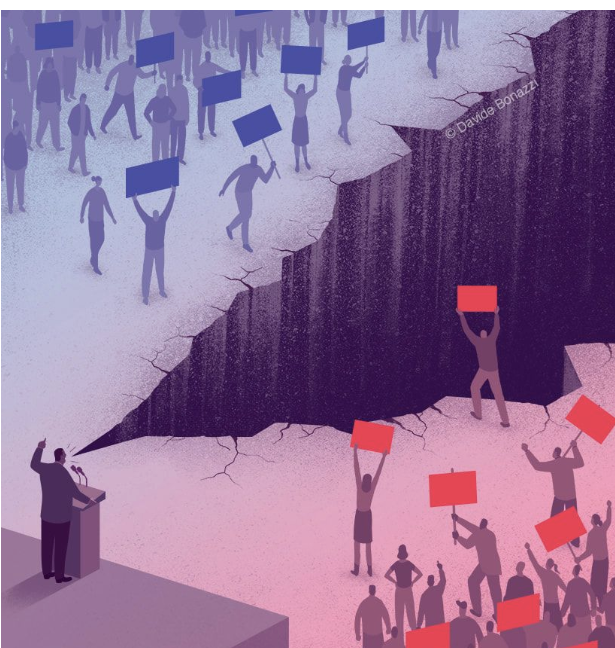
Humanity needs to exist in groups, and when we’re neglecting these processes, we are more likely to accept the requirements to stay in the group. These requirements could include voting for Trump, attacking the Capitol in an attempt at an insurrection, or systematically creating an entire belief system in your head that rationalizes and excuses all of these actions. People become more aligned with the idea of the party, and the plethora of common enemies the party has identified, than with the actual structural integrity of the ideologies themselves.

Once leaders recognize this phenomenon, they can use it as a tool to strategically shape a group of people into thinking thoughts that they would not normally think. They can move the beliefs of a group quite far from their origin, without any questioning, because the members of a strong coalition are not focused on the beliefs. Instead, they enjoy positive reinforcement, and a safe social tribe. This is the mass manipulation of millions of people. This should feel extremely frightening.
However, this is not the recipe for a societal apocalypse. Not all hope is lost. There is a great deal of irony in that once these coalitions “win,” or find power, they begin to fall apart, because they have no central gravity keeping them together. There is only the shared sentiment of not being something. For example, once that person that you and your “friend” hate moves away or switches to a different class, there is nothing keeping that bond alive anymore. No more shared side-eyed glances to strengthen that relationship, and it begins to fade away. It is this phenomenon that could happen to the extremist Republican party should they achieve the full power that they desire. However, they will likely engage in a conversion of power, routinizing themselves in a much more stable form of domination. The exact playbook, however, is impossible to predict.

While it is impossible for these groups to hold power forever, the immense importance of recognizing schismogenesis is imperative to prevent these groups from even gaining power in the first place. The next time you feel compelled to believe something, even if it is as small as listening to a new band, ask yourself, do I really enjoy this music, or am I just searching for a group to belong to? Furthermore, who does this group other? Does aligning myself with this identity create division? Does it have to?
There has been an eradication of the multifaceted person which prevents people from seeing the world in a nuanced perspective. There do not always have to be sides. There do not always have to be teams. Two things can and will continue to exist at the same time, just as a person can believe two different things at the same time. A coalition built off of division will fail long-term.